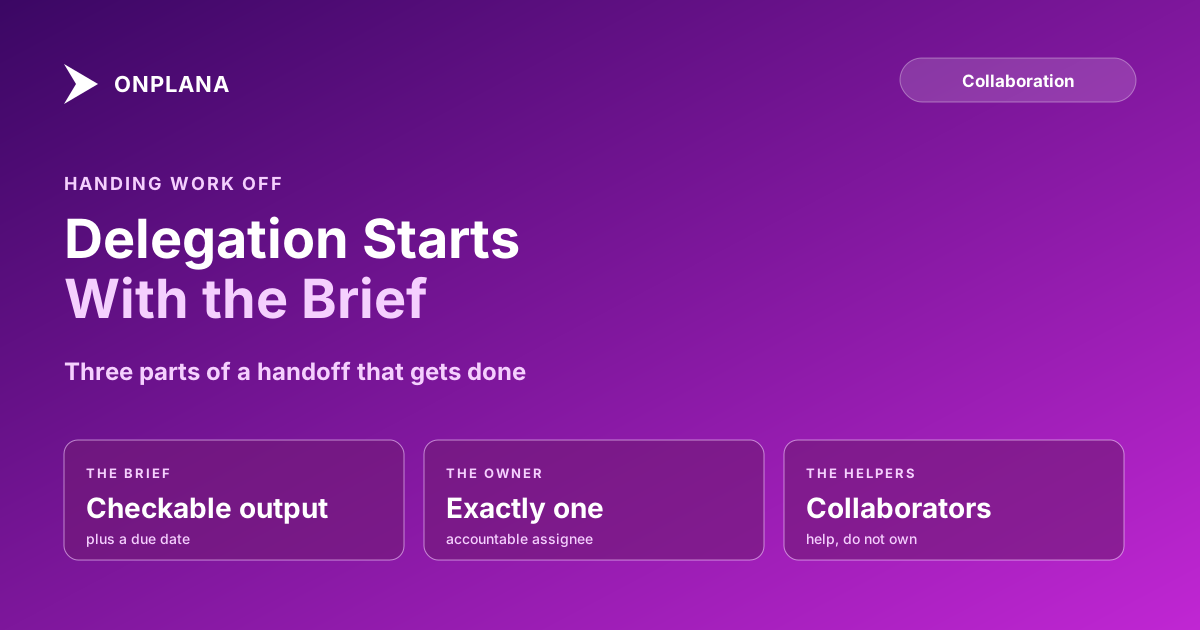
Task Delegation That Sticks: Brief, One Owner, Collaborators
Task delegation works when the task has a checkable output, one accountable owner and a due date. Here is the brief, the owner rule and the thread record.
Most delegation fails at the brief, not at the handoff. A task that says "sort out the vendor situation" gets a cheerful yes and, two weeks later, a status meeting; a task that says "get three written quotes by Friday and post them here" gets quotes. Delegation is also about to include software: Microsoft's 2024 Work Trend Index, published in May 2024, found that 42% of leaders extremely familiar with AI expect to be "training a team of AI bots" within five years, so the brief matters twice.
The direct answer: task delegation sticks when three things are written down before the task changes hands: a checkable output, one accountable assignee, and a due date. Everything else, the collaborators and the comment thread, supports those three.
In short. Delegation is a decision rule, not a personality trait. Give the task a result someone can check, name one owner, and let the helpers be collaborators. Keep the record in the task's comment thread. The same rule applies when the assignee is an AI agent, with a review step before anything leaves the building.
What goes into a delegation brief?
A delegation brief is the smallest piece of text that lets someone else start without asking you a question. It has four parts:
- The output. Name the thing that will exist when the task is done: a signed-off list, a draft, a decision with a rationale. "Look into" is not an output.
- The check. State how you will know it is right. "Matches the numbers in the budget tab" is a check; "looks good" is not.
- The due date. One date, and the reason for it if it is not obvious.
- The context. One link or sentence on why the task exists, so the assignee can make small judgment calls without coming back.
If you cannot write the check, that is the finding. The task is not ready to delegate, and the fastest fix is to decide what good looks like yourself, in two lines, before handing it over.
Why does a task need exactly one owner?
A task needs one accountable assignee because shared ownership is the most reliable way to guarantee that nobody does it. When two names sit on a task, each assumes the other is moving it. This is the same logic behind the single "A" in a RACI matrix: many people can be responsible, one is accountable.
In Onplana a task keeps one assignee and takes up to 20 collaborators, available on every plan (verified against the plan matrix in src/lib/plans.ts). Collaborators see the task in My Work, are notified when they are added and when someone comments, and can update it as their project role allows. They help; they do not own the outcome.
| Role on the task | Accountable for the result | Notified on comments | Typical use |
|---|---|---|---|
| Assignee | Yes, exactly one | Yes | The person who answers for it |
| Collaborator | No | Yes | Reviewer, specialist, backup |
| Mentioned person | No | Once, on the mention | A one-off question |
| Everyone else | No | No | Reads the project, not the task |
The diagram below shows the four parts of the brief feeding one owner, with collaborators attached to the side rather than sharing the owner box.
Where should the follow-up conversation live?
Follow-up belongs in the task's comment thread, not in a chat channel, because a thread keeps the decision attached to the work it changed. Each task has a comment thread with replies and @mentions, and the assignee is notified automatically when someone else comments (Onplana docs on comments and mentions). A question to a specialist is an @mention in that thread; the answer stays where the next person will look. The longer argument is in task comments vs a chat channel.
How do you delegate to an AI agent with the same rule?
You apply the same three parts and add a review step. In Onplana, Delegate to an agent on a task posts an @mention; the agent reacts on its next sync, and anything it produces lands in the Agent review inbox. Nothing is sent or published until a person approves it, and an agent never sends email on its own. Accountability does not move: the person who assigned the task and approves the output answers for it.
That is why the human and agent cases belong in one decision rule. The brief, the check and the single owner are identical; only the review step is explicit. The test for which tasks to hand an agent at all is in when to delegate tasks to an AI agent, and delegation vs pair programming with AI covers the other working mode.
What does not belong in a delegated task?
Judgment calls with no checkable answer stay with you. Telling a sponsor a date has slipped, choosing which scope to cut, and negotiating with a client cannot be reduced to an output plus a check. Delegate the preparation, such as the options and the numbers, and keep the decision.
What happens next: pick one task on your plate today, write the output and the check in two lines, name one assignee, and post it as the first comment. If you cannot write the check, you have found the real work. The wider setup for teams sharing one plan is on the team collaboration page.
Frequently asked questions
What is task delegation?
Task delegation is handing a piece of work to another person or an AI agent while you keep accountability for the result being right. The work moves; the answer to 'who is responsible if this is wrong' stays with whoever assigned it and approved the output.
How do you delegate a task so it actually gets done?
Write a brief with a checkable output and a due date, name exactly one accountable assignee, and keep the conversation in the task's comment thread. A task with those three parts gets done; one without them produces a status meeting.
Can a task have more than one owner?
No, and that is deliberate. A task has one accountable assignee plus up to 20 collaborators in Onplana, the other people working on it. Two owners means each can assume the other is handling it.
What is the difference between an assignee and a collaborator?
The assignee is accountable for the task being finished. A collaborator helps without owning the outcome: they see the task in My Work, are notified when they are added and when someone comments, and can update it as their project role allows.
Can delegating a task be a mistake even with a good brief?
Yes. Work that turns on judgment, such as telling a stakeholder unwelcome news or choosing which scope to cut, cannot be briefed into a checkable output. Keep the decision and delegate the preparation.
Can I delegate a task to an AI agent the same way?
Yes, and the same rule applies. Use Delegate to an agent on the task, which posts an @mention; the agent picks it up on its next sync, and what it produces lands in the Agent review inbox. Nothing is sent or published until a person approves it.
Where does this approach fall short?
A brief cannot fix an unclear goal. If the person delegating does not yet know what a good result looks like, the brief will be vague too, and the right move is to decide that first.
Ready to make the switch?
Start your free Onplana account and import your existing projects in minutes.