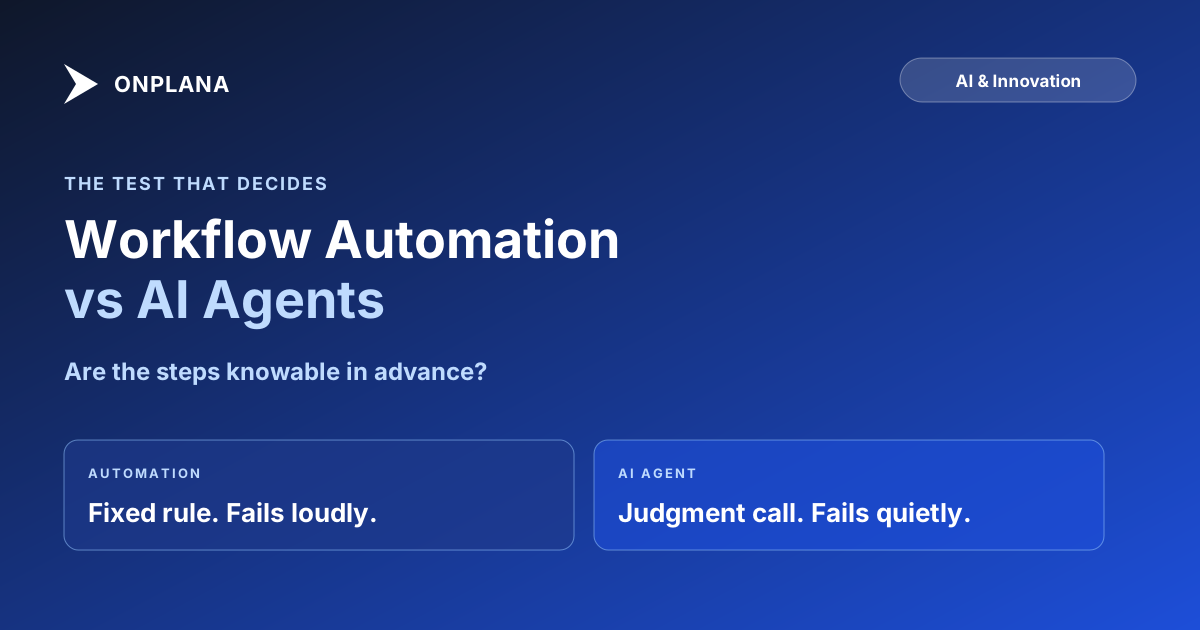
Workflow Automation vs AI Agents: The Actual Difference
Workflow automation vs AI agents comes down to one test: are the steps knowable in advance? If so, automate. If the path needs judgment, use an agent.
The most common mistake in a 2026 automation buying conversation is assuming "AI-powered" means agentic. It usually doesn't. Most of what ships under that label is a deterministic workflow with a language model doing one step in the middle, and the distinction is not pedantic: it decides whether the thing you bought fails loudly or fails plausibly.
The direct answer: workflow automation vs AI agents comes down to a single test. If every step and every decision point can be fully specified in advance, a deterministic workflow is the right tool: it is cheaper, faster, and it fails in a way you notice immediately. If the right next step depends on judgment that changes with context, an agent is the right tool, and the tradeoff you're accepting is that its mistakes are harder to catch, because they look like reasonable decisions instead of broken code.
A deterministic workflow runs the same sequence every time and fails loudly the moment its assumptions break. An AI agent evaluates its situation and decides what to do next, which lets it handle cases nobody wrote a rule for, at the cost of failing plausibly instead of visibly. The test is whether the steps are knowable in advance: if yes, automate. If the path genuinely depends on judgment, use an agent, and put a review gate where its judgment could be wrong.
What Deterministic Automation Actually Does
A deterministic workflow is a fixed sequence: trigger, condition, action. When a task passes its due date, notify the assignee. When a budget line crosses 90 percent of its allocation, flag it for review. Every branch the workflow can take was written down by a person before the workflow ever ran, which is exactly why it is predictable. Feed it a situation nobody anticipated and it does one of two things: nothing, or the wrong thing in an obviously wrong way, either of which is a bug someone will notice and fix.
That predictability is a feature, not a limitation. A rules engine is cheap to build, trivial to audit (the rule is the documentation), and it never makes a judgment call it wasn't authorized to make. Most of what a PMO actually needs automated, status notifications, overdue-task escalation, budget threshold alerts, fits this shape completely.
What Makes an AI Agent Different
An AI agent evaluates the situation and decides what to do next, rather than following a sequence a person wrote in advance. Anthropic's guide to building effective agents draws the same technical line: a system that perceives its environment, takes actions, and adapts based on feedback in pursuit of a goal, as distinct from a fixed pipeline that only executes steps a developer specified. Ask it to keep a project's schedule healthy and it will monitor for slippage, weigh which risk to surface first, and decide whether a finding is worth a person's attention today or can wait until the weekly review, none of which was spelled out step by step. AI agents vs AI features in project management covers the sibling distinction: an agent's defining property is that it keeps working, and keeps deciding, after the person who set it in motion has stopped watching.
That judgment is the entire value proposition and the entire risk. A deterministic workflow cannot handle a case its author didn't anticipate. An agent can, because it is reasoning about the goal rather than executing a script, but reasoning about a goal means it can also reach a plausible-sounding wrong conclusion that no rule would have produced, because no rule was checking its work. Human-in-the-loop versus on-the-loop covers how the review posture should change once you've decided a task needs an agent instead of a rule.
Workflow Automation vs AI Agents: The Test That Decides
| Dimension | Deterministic automation | AI agent |
|---|---|---|
| How it decides | Fixed rule written in advance | Evaluates context against a goal |
| Handles the unexpected | No, stalls or errors | Yes, that's the point |
| Failure mode | Loud: stalls, throws an error | Quiet: completes plausibly, just wrong |
| Auditability | The rule is the documentation | Needs a logged reasoning trail |
| Build cost | Low | Higher, plus review infrastructure |
| Best fit | Steps and criteria fully knowable | Path depends on judgment |
| Review needed | Rarely, rule is static | Ongoing, especially early on |
The dividing line is whether the steps are knowable in advance, not whether the problem sounds complicated. A twelve-step approval chain with clear criteria at each gate is still deterministic, no matter how many steps it has. A three-step task that requires reading a comment thread and deciding whether a deadline slip is actually a problem needs judgment, which means it needs an agent even though it's structurally simpler.
The diagram below walks through the test in the order it should actually be asked.
Why the Two Get Sold as the Same Thing
Vendors have an incentive to blur this line. Agent pricing runs higher than automation pricing, and a workflow with a language model doing one step, "when a task is overdue, ask AI to draft a risk note", looks impressive enough in a demo that calling it an agent is tempting even though the trigger is still deterministic and the AI is just a processing step, not the thing deciding what happens next. The honest test cuts through the marketing: does the system decide what to do based on a goal, or does it run a fixed sequence when triggered? If the answer is the second one, the price should match a rule, not a reasoning system.
The Honest Answer: Most Portfolios Need Both
The realistic answer for most PMOs is not "pick one architecture." It's routing each automation need to the one that fits. Status notifications, overdue escalation, budget alerts: deterministic, and building an agent for these is over-engineering that adds review overhead nobody needed. Continuous portfolio risk monitoring, drafting a status report that reads the actual schedule state, deciding which of forty flagged items deserves a PM's attention this week: these need judgment that a fixed rule set cannot anticipate, which is where autonomy levels become the right framework, because the review gate should scale with how much judgment the task actually requires.
Onplana ships both patterns rather than forcing one architecture to cover every case: deterministic workflow automation rules with approval steps and condition branching for the knowable parts of a portfolio, and an agent layer for the parts that genuinely need ongoing judgment, like nightly risk detection across a full project set. Picking the wrong architecture for a given automation need is what makes teams distrust AI generally, not the technology itself; the fix is asking the one-sentence test before building either one. The rest of the Onplana blog covers the adjacent decisions that follow once you know which architecture a given task actually needs.
Frequently asked questions
What's the difference between workflow automation and an AI agent?
Workflow automation runs a fixed sequence of steps and fails loudly the moment reality doesn't match what it expected. An AI agent evaluates the situation at each step and decides what to do next, which means it can handle the unexpected, and also means it can fail plausibly instead of loudly.
When should I use deterministic automation instead of an agent?
Whenever the steps and the decision criteria are fully knowable in advance: if a task is overdue, notify the owner; if a budget crosses 90 percent, flag it. If you can write the rule as an if-then statement that never needs judgment, a rules engine is faster to build, cheaper to run, and easier to audit than an agent.
Can an agent fail silently where a deterministic workflow would have failed loudly?
Yes, and this is the real cost of the extra flexibility. A broken automation throws an error or stalls, which is annoying but visible. An agent that misjudges a situation can complete the task anyway, just not the way anyone intended, and nothing necessarily flags that it happened.
Who is accountable when an agent makes a call a workflow rule never would have made?
Whoever gave the agent the goal and the scope to pursue it, the same accountability chain as any other delegated decision. A deterministic rule has no judgment to answer for; an agent's judgment is exactly what someone has to own before it runs unattended.
Can a vendor sell rebranded automation as an 'agent' and charge an agent price for it?
Yes, and it happens constantly. The test is simple: does the system decide what to do next based on a goal, or does it just run a fixed sequence when triggered? A trigger-and-branch automation with an AI step in the middle is still deterministic; calling it an agent is a pricing choice, not an architecture.
Do most teams need agents, or is deterministic automation enough?
Most teams need both, applied to different problems. The mistake isn't picking the wrong one, it's assuming one architecture should handle every automation need in the portfolio, which produces either an overbuilt agent for a problem that never needed judgment or a brittle rule chain for a problem that always did.
Ready to make the switch?
Start your free Onplana account and import your existing projects in minutes.