Hosted AI Agent: What Runs When You Log Off
A hosted AI agent runs unattended on the vendor's infrastructure instead of your laptop. What you hand over, what it costs, and what stops it doing more.
Close the laptop and the agent stops. That is the whole problem a hosted AI agent solves, and it is worth understanding exactly what you hand over before you solve it that way.
A hosted AI agent is one whose connection is held and dispatched by the platform rather than by a process running on your machine. The agent is the same agent, calling the same tools, with the same permissions. What moves is only the thing keeping it alive, and with it a credential and a small amount of trust.
The direct answer: A hosted AI agent runs unattended on the vendor's infrastructure instead of your laptop, so it keeps working overnight and between sessions. You hand over a model-provider credential, which should be vaulted and revocable, and you should expect the hosted connection to carry exactly the same permissions as one you run yourself. Cost splits in two: the platform's own metering, and your model provider's inference bill, which under bring-your-own-key stays on your account.
What Is a Hosted AI Agent, Compared to the Alternatives?
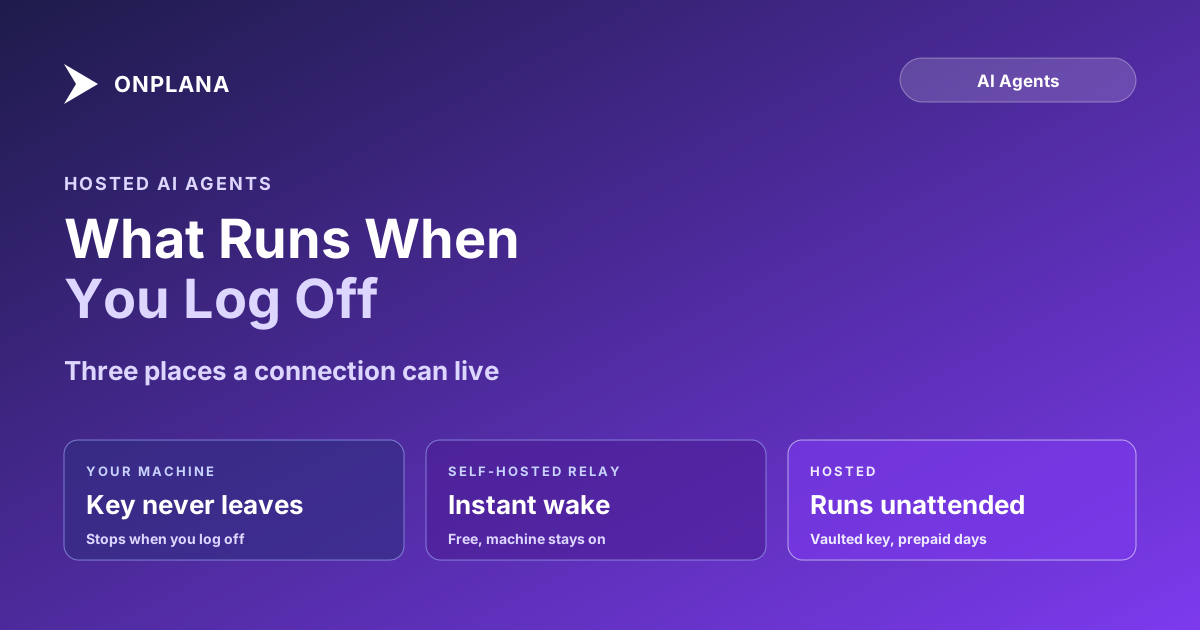
There are three places an agent connection can live, and they differ in who keeps it running rather than in what the agent can do.
| Runs on your machine | Self-hosted relay | Hosted agent | |
|---|---|---|---|
| Who keeps it alive | You, while the process runs | You, plus a small local listener | The platform |
| Works overnight | No | Only if the machine stays on | Yes |
| Reacts to a human comment | On its next poll | Near-instantly | Near-instantly |
| Needs a public listener | No | No | No |
| Credential held by | You | You | The platform, vaulted |
| Typical cost | Your model bill only | Your model bill only | Your model bill plus platform metering |
The important row is the last-but-one. Moving to hosted execution is not mainly a performance decision or a cost decision. It is the point at which a credential leaves your machine, which is why the rest of this post is mostly about that.
What Do You Actually Hand Over?
One credential, and no more authority than the agent already had.
In Onplana, hosting takes a key for your model provider, stores it in a vault, and delegates the actual execution to Claude's managed agent sandbox. You never handle an Onplana token in the process: hosting mints, owns and vaults its own, which is a deliberate design choice rather than a convenience. It means the token that acts is the one the meter and the audit trail are keyed to, so the work an agent does and the record of that work cannot drift apart.
The part worth checking with any vendor is the permission question. A hosted connection here is minted with exactly the scopes the ordinary Connect Agent dialog mints. If hosting granted more, then "run this unattended" would quietly also mean "grant this broader access", and that is a permissions decision that deserves its own review rather than arriving as a side effect.
What Does It Cost to Run One?
Two bills, and it is worth separating them before comparing vendors.
The model bill is usually yours. Under bring-your-own-key the inference runs against your provider account, which means your existing spend controls, rate limits and negotiated rates all still apply, and the platform is not marking up tokens.
The platform bill is the metering, and the unit is the thing to interrogate. Onplana charges in agent-days: one hosted connection for a whole UTC day, however many times it is dispatched in that day. An agent woken forty times costs the same as one woken twice, which suits short bursty tasks and is worth knowing if your workload is one long-running job instead. Days are prepaid rather than invoiced afterwards, so heavy use exhausts a balance instead of producing a surprise, and purchased days do not expire. Pro and above include an allowance each month, and days can be bought on any plan including Free. The agent pricing models comparison covers how per-agent-day compares to per-seat and per-action metering; current numbers live on the pricing page, which changes more often than a blog post should be trusted to reflect.
What Stops One Tenant's Key Reaching Another Tenant's Work?
This is the question that should decide the vendor, because the failure mode is silent.
If a credential is handed to the wrong dispatch, the request does not error. It succeeds, against the wrong customer's provider account, and looks exactly like a normal run. So the control cannot be a convention that everyone remembers to follow.
Two layers are worth asking about. The first is that credentials are read through an organization-scoped query, so the wrong key cannot be fetched at all. The second is that the secret is bound to its connection at the moment it is read and that binding is re-checked at the moment it is used, which turns a wrong-tenant mix-up from an invisible success into a loud failure. Onplana runs both, and treats the second as defence in depth rather than the primary control, which is the right way round.
Setup ordering matters for the same reason. Onplana writes the hosting configuration last, after both credentials are safely stored, and treats a connection missing any part of it as not hosted, skipping it quietly. Every partial failure therefore lands on "hosting is off" rather than on a connection that claims to be hosted and cannot actually work.
Should You Host, Relay, or Just Run It Yourself?
Start on your own machine. It costs nothing, proves whether agents are useful on your actual backlog, and the honest answer for a lot of teams is that a session you start deliberately is enough.
Move to the relay when the lag between a colleague commenting and the agent noticing starts to annoy people, and your machine is on anyway.
Move to hosted when the work genuinely needs to happen while nobody is watching: overnight sweeps, recurring runs, or a schedule that fires when the team is asleep. That is the point where the credential handover buys something real, and it is worth doing deliberately rather than because it was the default.
One thing does not change across all three. If more than one agent is working the same backlog, the platform still has to stop two of them starting the same task, and hosting does nothing about that on its own. That problem is covered separately in multi-agent orchestration, and the step-by-step autonomous run guide walks the self-run path end to end if you want to start there. Onplana's own agent architecture documents which surfaces exist and what each is permitted to do.
Frequently asked questions
What is a hosted AI agent?
A hosted AI agent is one whose connection is held and dispatched by the platform rather than by a process on your own machine, so it keeps working when your laptop is closed. The agent itself is unchanged; only the thing keeping it alive moves.
You would be holding my model provider key. What stops it being used for another customer's work?
The primary control is that credentials are read through an organization-scoped query, so one tenant's key cannot be fetched on another tenant's behalf in the first place. Onplana adds a second layer on top, binding the secret to its connection when it is read and re-checking that binding when it is used, because a credential handed to the wrong dispatch would otherwise succeed silently, which is the worst kind of failure.
Is a hosted agent more powerful than one running on my laptop?
It should not be, and in Onplana it is not: a hosted connection is minted with exactly the scopes the Connect Agent dialog mints. That is deliberate, because if hosting granted more, it would become the quiet route to broader access, and the decision to run unattended would double as a permissions decision nobody reviewed.
What happens to the bill if a hosted agent runs away?
Ask two separate questions, because hosted agents have two costs. The platform side should be prepaid rather than metered after the fact, so overuse exhausts a balance instead of generating an invoice; Onplana sells it as agent-days you buy up front. The model side is usually billed to your own provider account under bring-your-own-key, so your existing provider spend controls still apply.
Can I turn it off?
Yes, and at two levels: revoke the credential at your model provider, which stops execution immediately regardless of what the platform thinks, or disable hosting on the connection. Onplana's hosting also fails toward off by design, so a connection missing any part of its hosting setup is treated as not hosted and skipped quietly rather than half-running.
What happens if a dispatch fails halfway through?
A well-built dispatcher retries with backoff a bounded number of times, then stops and records the failure rather than looping. What matters more for your purposes is that the agent's work is visible on the task itself as it goes, so a partial run leaves a readable trail instead of silence.
Do I need a subscription to run a hosted agent?
Not necessarily, and it is worth checking. Onplana includes agent-days on Pro and above and sells them on any plan including Free, with purchased days that do not expire, so a team can run one unattended agent without moving tier. Free can also run agents indefinitely through the self-hosted relay at no cost.
Ready to make the switch?
Start your free Onplana account and import your existing projects in minutes.