Human in the Loop vs on the Loop for AI Agents
Human in the loop approves each action before it happens; human on the loop watches a stream and steps in after. Here's the test for which task needs which.
Human in the loop and human on the loop get used as if they're the same caution dressed in different words. They're not. They describe opposite relationships between a person and an agent, and mixing them up is how a governance policy ends up unenforceable the first time someone asks "so who actually has to look at this before it happens?"
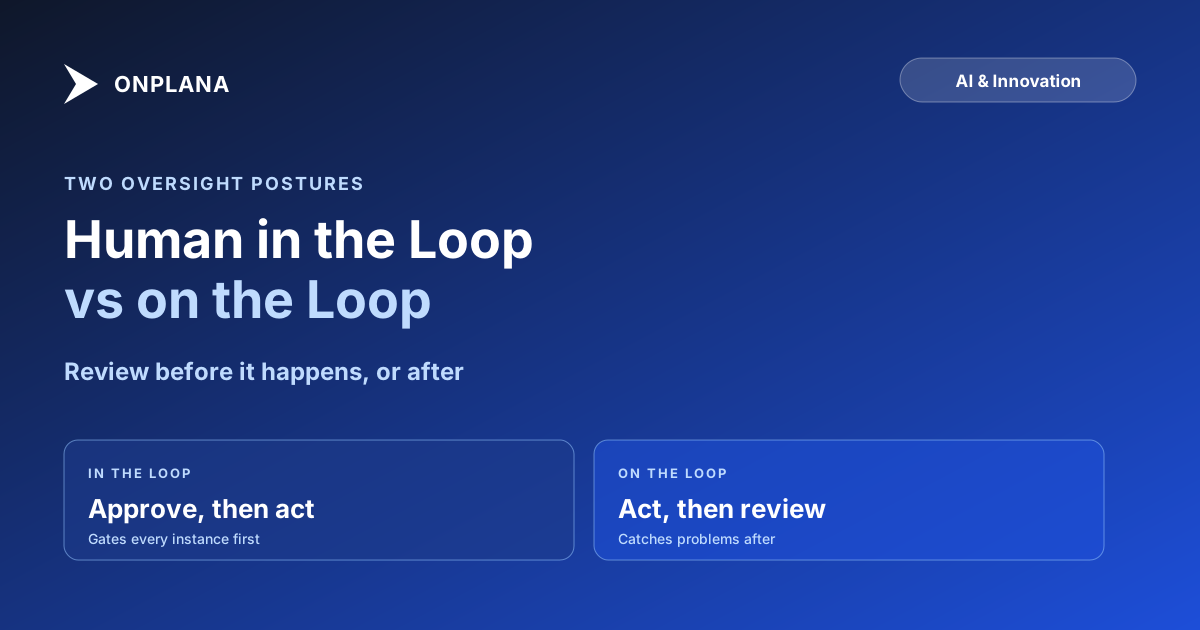
The direct answer: human in the loop means a person approves an agent's action before it takes effect. Human on the loop means the agent acts on its own, and a person monitors a stream of completed actions and intervenes when something looks wrong. In the loop gates before; on the loop reviews after. The two postures suit different tasks, and the test for which one a task needs comes down to two questions: how expensive is the action to undo, and is the audit trail good enough to catch a bad call after the fact.
Human in the loop approves every action before it happens: nothing becomes real without a person saying yes first. Human on the loop lets the agent act unattended and reviews a stream of completed actions afterward, catching problems rather than preventing them. In-the-loop suits new, expensive-to-undo, or high-stakes work; on-the-loop only works when the action is cheap to reverse and the audit trail is complete enough to review after the fact. Neither posture is safer in general; each is safer for a specific class of task.
Human in the Loop vs on the Loop: The Core Difference
The two postures answer the same question, "when does a human look at this," with opposite timing.
| Human in the loop | Human on the loop | |
|---|---|---|
| When review happens | Before the action takes effect | After the action has already happened |
| What the human does | Approves, edits, or rejects a draft | Monitors a stream, intervenes on exceptions |
| Review volume | Every instance | Sampled, or exception-flagged only |
| Best suited to | New, high-stakes, or hard-to-reverse work | High-volume, low-variance, cheap-to-reverse work |
| What it requires | An approval gate the output can't skip | A complete, queryable audit trail |
| Failure mode if misapplied | Approval fatigue, rubber-stamping | A bad action lands before anyone notices |
Neither row is the "correct" posture. A PMO that runs everything in-the-loop drowns in approvals for work that was never risky. A PMO that runs everything on-the-loop finds out about a wrong rebaseline three days after the fact, from a confused stakeholder instead of a review screen. The five levels of AI agent autonomy map this same territory in finer detail: levels one and two are in-the-loop by definition, and levels three through five are on-the-loop, with the review burden dropping as the level rises.
When In-the-Loop Is the Right Posture
In-the-loop belongs on anything where the cost of being wrong lands somewhere other than "redo a few minutes of work." A schedule rebaseline, a customer-facing date change, a resource reassignment that could overload someone who was already at capacity: these are exactly the operations where a person should see the proposal, the evidence behind it, and decide before it becomes the plan of record. Onplana's propose-ratify agents run this pattern by default on operations scored as expensive to undo: the agent drafts the change and attaches its evidence, and nothing commits until a person ratifies it. The agent review inbox is the same in-the-loop gate applied at the artifact level: whatever an agent drafts, from a document to a status report, sits there until a person approves or rejects it.
In-the-loop is also the right default for any task class an agent hasn't handled before, regardless of how reversible the action is. A team with no track record on a task has no acceptance-rate evidence yet, and evidence is what eventually justifies loosening the gate.
When On-the-Loop Is the Right Posture
On-the-loop earns its place on high-frequency, low-stakes work where gating every instance would cost more in review time than the occasional mistake costs to fix: task-status parsing, routine comment drafting, tagging. The posture only works, though, if the audit trail is actually good enough to reconstruct what happened, who or what triggered it, and what the agent read before acting. An on-the-loop system with a thin log is not oversight; it's an unmonitored system with a reassuring name. Audit trail requirements for agent work covers what "good enough" means in practice: every action queryable in the same log as human activity, not a client-side trace a vendor can't produce on request.
The diagram below shows the same operation moving through both postures, and where the human's attention actually lands in each.
The Test for Which One a Task Needs
Two questions settle it for a given task class, not a whole agent or a whole tool.
- How expensive is the action to undo if the agent is wrong? Cheap to reverse, low external cost: on-the-loop is a candidate. Expensive to undo or costly to someone outside the task: keep it in-the-loop regardless of how reliable the agent has been elsewhere.
- Is the audit trail complete enough to catch a bad call after the fact? If reconstructing what the agent read and why it acted takes a support ticket instead of a query, the task isn't ready for on-the-loop no matter how reversible the action is.
A task only moves from in-the-loop to on-the-loop after it clears both questions, and the evidence for question one should come from a real acceptance-rate track record, not an assumption about how the task "should" behave.
Where Teams Get This Wrong
The common mistake runs one direction more than the other: teams move a task class to on-the-loop because the volume got annoying to gate, not because the audit trail and the error cost actually justified it. The tell is a review process built to placate an approval queue rather than to catch a wrong call, which is a sign the team solved the wrong problem. On-the-loop is a real oversight posture, but only when the "loop" part, the audit trail a human can actually check, was built before the gate was removed, not after. NIST's AI Risk Management Framework makes the same point in more general form: oversight has to track a system's actual, measured reliability, not the ambition of the rollout plan.
Treat the two postures as different tools for different task classes, not a maturity ladder every team eventually climbs to the top of. Some work should stay gated indefinitely because being wrong is expensive in a way volume never justifies loosening. The rest of the Onplana blog covers the adjacent decisions: how autonomy scales by level, what a governance policy should require, and what the audit trail underneath either posture actually needs to hold up under review.
Frequently asked questions
What's the difference between human in the loop and human on the loop?
In the loop means a person approves each action before it takes effect; on the loop means a person monitors a stream of actions the agent has already taken and intervenes when something looks wrong. One gates before, the other reviews after.
Which posture should a new agent deployment start with?
In the loop, on the task classes that are new or expensive to undo. On the loop is something a task class earns after in-the-loop review shows a low, stable error rate, not a default a vendor ships on day one.
Can on-the-loop miss something the agent gets wrong before real damage happens?
Yes, that's the honest tradeoff: on-the-loop reviews after the action is already real, so a bad call can land before anyone catches it. That's why on-the-loop only belongs on work that's cheap to undo or low-stakes if it's wrong, never on irreversible actions.
Who is accountable if an on-the-loop agent acts and it's later found wrong?
The person or team who decided that task class qualified for on-the-loop review, not the agent. Choosing on-the-loop is a decision to accept a delayed-catch error rate in exchange for not gating every instance, and that decision belongs to whoever made it.
Can someone steer an on-the-loop agent through a comment without anyone reviewing first?
Only if the review posture is a habit instead of a system control. On-the-loop is safe when the audit trail makes every action reviewable after the fact regardless of how it was triggered; it stops being safe the moment review depends on someone remembering to look.
Does on-the-loop require different tooling than in-the-loop?
Yes. In-the-loop needs an approval step the agent's output can't skip. On-the-loop needs a queryable, complete audit trail and a way to flag anomalies, because the entire posture depends on a human being able to reconstruct what happened after the fact.
Can a task be moved back from on-the-loop to in-the-loop?
Yes, and it should happen the moment the acceptance rate drops or an error surfaces that the audit trail didn't catch quickly. Moving back down is a routine adjustment, not an admission that the agent failed.
Ready to make the switch?
Start your free Onplana account and import your existing projects in minutes.