AI Pair Programming vs Delegation: Two Models
AI pair programming vs delegation is a choice about economics, not comfort. Pairing scales with your attention; delegation scales with your review capacity.
Most teams reach for pairing with an agent by default, one person, one suggestion at a time, accept or reject, because it feels like the careful choice. It usually is not the safer choice. It is the familiar one, and the two are not the same thing.
The direct answer: AI pair programming vs delegation comes down to what scales the work. Pairing keeps a human in every decision as it happens, which means the pace of work is bounded by how long a person can hold focused attention on one thing. Delegation hands over a defined task and checks the finished result, which means the pace of work is bounded by how much output a person can review, not by how long they can watch. Most teams default to pairing on work that would delegate fine, because delegation demands a better-written task than pairing ever required, and writing that task well is the actual skill teams underinvest in.
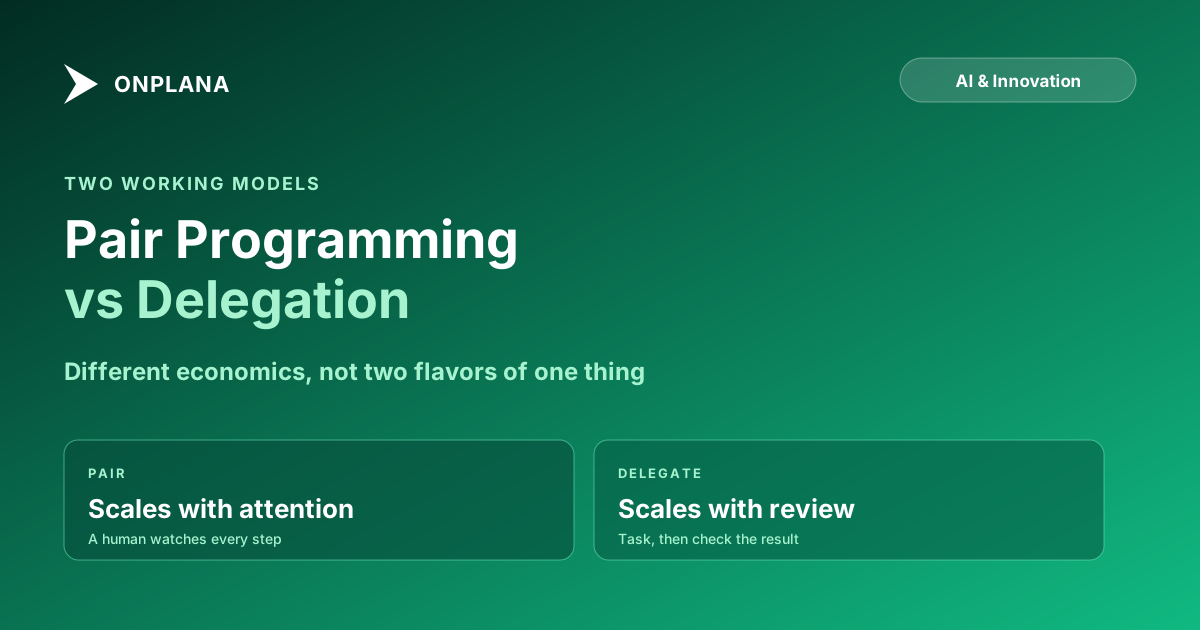
Pairing and delegating are different working models with different economics, not two flavors of the same thing. Pairing scales with a human's attention: one agent, one person, real time. Delegation scales with review capacity: many tasks can run at once, bounded by how fast the results get checked. Delegation is usually the better fit for defined, verifiable work, but it demands a task specification good enough to review against, which is the real reason teams under-delegate. Pick the model by asking whether the task can be written down completely enough to check the result without having watched it happen.
AI Pair Programming vs Delegation: The Core Difference
Pairing puts a human in the loop on every suggestion: the agent proposes a line, a function, a fix, and a person accepts, edits, or rejects it before it becomes real. Nothing happens that a human did not just watch happen. Delegation removes the human from that moment entirely. A task goes to the agent with a specification and an acceptance bar, the agent works through it unattended, and a human reviews the finished result, not the path taken to get there. The five levels of AI agent autonomy map this same territory in finer detail; pairing sits near the bottom of that ladder and delegation sits in the middle to upper rungs, depending on how much review happens before the result counts as done.
What Pairing Actually Costs
Pairing's cost is presence. A person has to be there for the whole session, which means the total pairing throughput on a team is capped by how many hours its people can spend watching an agent work, not by how many agents the team could technically run. That cap does not move no matter how good the underlying model gets, because the bottleneck was never model quality; it was always a human's available attention. Pairing earns its cost back on work where the shape of the task is still being discovered as you go: an unfamiliar codebase, an ambiguous bug, a design decision that needs a human's judgment at each fork. On that kind of work, continuous presence is not overhead, it is the thing actually producing the value.
What Delegation Actually Costs
Delegation's cost moves to the front of the process: writing a task specification tight enough that a correct result is checkable without having watched the work happen. That is a harder skill than most teams expect, because pairing let vague task definitions slide, a person mid-session could just clarify verbally as ambiguity came up. Delegation has no mid-session clarification. An underspecified task does not fail loudly; it produces a confident, plausible, wrong result that reads as finished, and the review step is the only thing standing between that result and something shipping. Onplana's agent skill is built around exactly this handoff: a plan, a task with acceptance criteria, an agent that works it unattended, and a verification step before anything gets marked done, because the review gate is where a delegation model actually earns its safety, not an optional add-on to it.
The Task Properties That Decide Which Fits
| Property | Favors pairing | Favors delegation |
|---|---|---|
| How well-defined is the task | Still being discovered as you work | Fully specifiable up front |
| How checkable is the result | Hard to verify without having watched | Checkable against clear acceptance criteria |
| Volume of similar work | One task at a time | Many similar tasks in parallel |
| Cost of a wrong result | High, needs a human at each step | Bounded, catchable at review |
| Where the bottleneck sits today | Idle agent capacity, scarce human time | Idle human review time, scarce agent capacity |
The diagram below shows the same choice as a fork: what the task looks like on one side, which model actually fits it on the other.
Why Teams Default to Pairing When They Should Delegate
The honest reason most teams under-delegate is not caution, it is that delegation exposes a gap pairing let them ignore: the task was never actually specified, it was negotiated verbally as the work happened. Moving that same task to delegation means writing down the acceptance bar before work starts, and teams that have never had to do that find it harder than the coding itself. The fix is not to stay in pairing mode by default; it is to treat task specification as the skill delegation requires and build it deliberately, the same way review discipline had to be built before agents could touch a pull request at all. AI agents in software development covers the sibling question of which SDLC stages suit an agent at all; this is the layer above it, choosing the working model once you know the stage fits.
Getting the Choice Right
- Default to delegation for anything fully specifiable. If the acceptance bar can be written down before work starts, write it down and delegate; pairing on it is spending human attention you did not need to spend.
- Default to pairing when the task is still being discovered. Exploratory debugging, unfamiliar code, and open design questions need a human at each fork, not a specification that does not exist yet.
- Invest in task-writing as its own skill. A team's delegation ceiling is set by how well it writes tasks, not by how capable the agent is.
- Put a real review gate on delegated work, matched to the task's cost of being wrong, not a rubber stamp. Human in the loop vs on the loop covers how to size that gate to the actual stakes.
- Move a task back to pairing the moment delegated output on it is wrong often enough that review alone is not catching it in time.
Getting this right is a matter of matching the model to the task, not picking a house style and applying it everywhere. The rest of the Onplana blog covers where agent judgment holds up across the delivery pipeline and where it still needs a human closer to the work.
Frequently asked questions
What's the actual difference between AI pair programming and delegating to an agent?
Pairing keeps a human in every decision, watching each suggestion and accepting or rejecting it in real time. Delegation hands over a defined task and reviews the finished result, not the steps taken to get there. One scales with your attention span; the other scales with how much output you can review.
Which model scales better as a team takes on more work?
Delegation, almost always. Pairing time grows roughly linearly with the number of things you pair on, because a human has to be present for each one. Delegated work can run in parallel across many tasks at once, bounded only by how fast a human can review what comes back.
Can a delegated task ship something wrong without anyone catching it in time?
Yes, and that is the real risk pairing avoids by construction. Delegation trades continuous oversight for after-the-fact review, so a task with a vague specification or no verification step can produce confident, wrong output that looks finished. The fix is a tighter task definition and a review gate, not reverting to pairing on everything.
Who is accountable when delegated work turns out wrong?
Whoever assigned the task and whoever approved the result, not the agent. Delegating a task is a decision to trade per-step visibility for review-at-the-end, and that trade belongs to the person who made it, the same as approving a colleague's pull request without reading every line makes the approver responsible for what shipped.
Can someone steer a delegated agent off course through a vague or misleading task description?
Yes, more easily than most teams expect. An agent working from a written task treats that text as the ground truth, so an ambiguous acceptance criterion gets filled in with the agent's best guess rather than flagged as a gap. Tight task definition is not bureaucracy here; it is the actual safety mechanism delegation depends on.
Does delegating to an agent mean less human involvement in the work?
Less involvement in the steps, not in the outcome. The human moves from watching each keystroke to writing the task well and reviewing the result rigorously, and a sloppy version of either step is where delegation actually fails, not the act of delegating itself.
How do you tell whether a task should be paired or delegated?
Ask whether the task can be written down completely enough that a correct result is checkable without having watched it get built. If yes, delegate it and review the output. If the task itself is still being discovered as you go, pairing keeps you in the loop while the shape of the work is still forming.
Ready to make the switch?
Start your free Onplana account and import your existing projects in minutes.