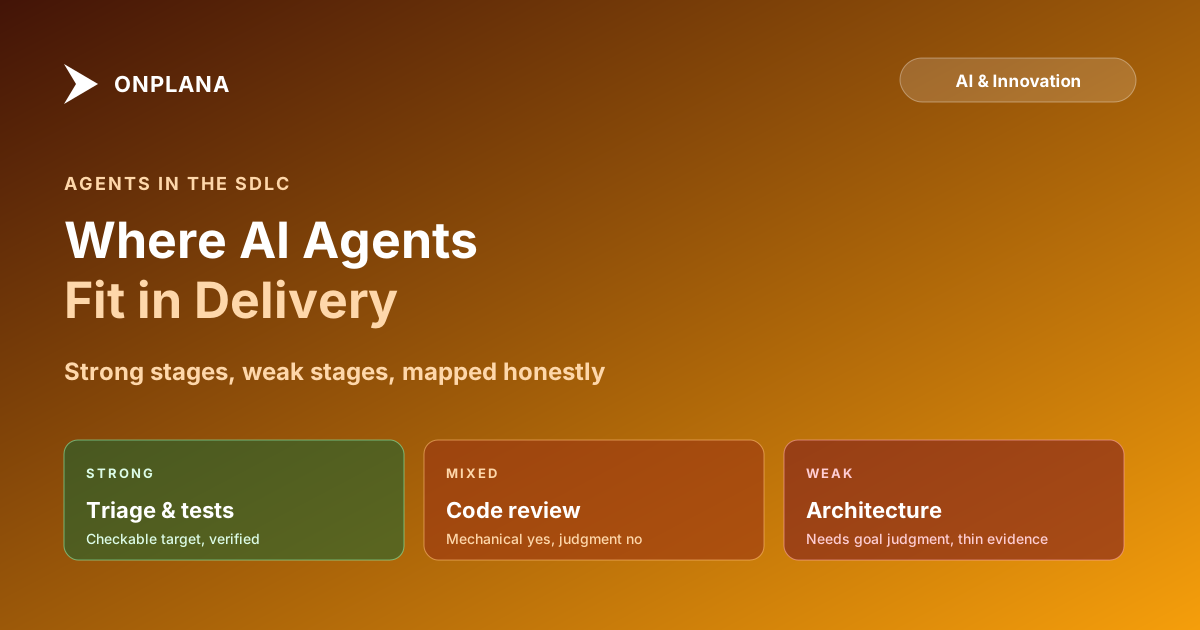
AI Agents in Software Development: Where They Fit
AI agents in software development are strong at triage, reproduction, and mechanical fixes, and weak at architecture and judging whether a requirement is right.
Ask an engineering team six months into using an AI agent where it actually earned its keep, and the answer is never "the whole SDLC." It's issue triage, bug reproduction, and the kind of mechanical fix that used to eat an afternoon. Ask the same team where the agent quietly caused the most rework, and the answer is architecture decisions and requirements the agent treated as correct because nothing told it otherwise.
The direct answer: AI agents in software development are strong across specific stages, triage, reproduction, test writing, and mechanical code changes with a clear, verifiable target, and weak at architecture decisions and at recognizing when a requirement itself is wrong. Both weak spots require judgment about a goal, not execution against one, and that's the kind of judgment an agent optimizing for a stated goal has no built-in way to exercise. Map the agent onto the lifecycle stage by stage instead of treating "AI in the SDLC" as one capability.
AI agents fit unevenly across the software delivery lifecycle: strong at triage, bug reproduction, test writing, and mechanical fixes checkable against a test or a repro step; weak at architecture and at judging whether a requirement is actually correct. The evidence for the strong stages is solid; the evidence for the weak ones is thin, and teams that treat the whole SDLC as one capability end up over-trusting the stages where an agent's confidence is not backed by the same kind of verifiable target.
Where Agents Are Actually Strong: Triage, Reproduction, Mechanical Change
The stages where agents perform well share a structural feature: there's a checkable target. A failing test either passes or it doesn't. A bug either reproduces with the given steps or it doesn't. A mechanical refactor, renaming a function across a codebase, updating a deprecated API call, either compiles and passes the existing test suite or it doesn't. Where this shows up in practice, in issue tracking built around exactly this list, is sorting a backlog of incoming issues by severity and likely cause, reproducing a reported bug from a description, and drafting the first pass at a fix a person then reviews. None of these require the agent to decide whether the underlying goal is worth pursuing; they require it to execute against a target that already exists.
Where the Evidence Runs Thin: Architecture and Requirement Judgment
Architecture decisions and requirement judgment sit on the other side of that line, and the evidence for agent competence here is thin rather than strong. Choosing a data model, deciding whether a service boundary belongs in one system or two, weighing a short-term fix against a long-term one: these decisions trade off goals against each other, and an agent has no reliable way to know which tradeoff the business actually wants. The same gap shows up earlier, at the requirement itself. An agent asked to implement a specification will implement the specification, including a specification that's wrong, because nothing in the task tells it to question the goal rather than execute it. Deterministic automation versus agentic automation covers a version of this same boundary from the workflow side: a deterministic step does exactly the same thing every time by design, while an agentic step makes a judgment call, and judgment calls about whether a requirement is right belong to the category evidence doesn't yet support handing over.
Mapping AI Agents in Software Development Onto the Delivery Lifecycle
| SDLC stage | Agent strength | Why |
|---|---|---|
| Requirements definition | Weak | Needs judgment about whether the goal itself is right, not execution against it |
| Architecture and design | Weak | Tradeoffs between goals, with no checkable target to verify against |
| Implementation (mechanical) | Strong | Compiles, passes tests: a clear, checkable target |
| Test writing | Strong | Coverage and pass/fail are directly verifiable |
| Code review | Mixed | Can flag mechanical issues; judgment calls on tradeoffs still need a person |
| Triage and bug reproduction | Strong | Severity and repro steps are checkable against evidence in the report |
| Maintenance and mechanical refactors | Strong | A clear before/after target with automated verification |
The diagram below lays the same stages along the delivery lifecycle, colored by how much evidence currently supports agent competence at each one.
Why "Can It Write the Code" Is the Wrong First Question
Evaluating an agent by whether it can produce working code skips the question that actually predicts where it will cause rework. Almost any capable agent can produce code that compiles and looks reasonable; the question that separates a good outcome from a bad one is whether the task it was given had a checkable target in the first place. A mechanical fix with a failing test to satisfy has one. "Redesign this service boundary" does not, and an agent handed that task will still produce a confident, well-formatted answer, because fluency doesn't require the underlying judgment to be sound. What is a tool call covers the mechanism this rests on: the model proposes an action and the system checks it, but nothing in that cycle checks whether the goal behind the action was the right one to pursue.
Deciding Where to Start
Teams that get the most value start with the stages that already have a checkable target: triage, reproduction, test writing, and well-scoped mechanical fixes, then expand carefully as the evidence for a given stage improves rather than assuming it applies uniformly. Technical project manager versus engineering manager covers the adjacent question of who owns that expansion decision on a delivery team, since it's rarely a purely technical call. The rest of the Onplana blog's AI and Innovation coverage goes further into the governance and permission questions that follow once agents are running inside a real delivery pipeline rather than a pilot.
Map the lifecycle before expanding the mandate: the stages with a checkable target are ready now, and the stages that need judgment about the goal itself are not, no matter how confident the output looks.
Frequently asked questions
Where are AI agents strongest in software delivery?
Triage, bug reproduction, test writing, and mechanical code changes with a clear, verifiable target: cases where correct can be checked against a failing test or a reproduction step, not judged by taste. Those stages reward exactly what an agent does well, fast, tireless, mechanical work against a checkable target.
Where do AI agents fall short in the SDLC?
Architecture decisions and recognizing when a requirement itself is wrong. Both need judgment about whether a goal is the right one, and an agent optimizing for a stated goal has no built-in way to question whether that goal should exist in the first place.
Can an agent make an irreversible change to production code on its own?
Yes, if the permission scope around it allows it, the same as any credential with write access. The fix is denying deploy actions and destructive migrations by default regardless of how confident the agent's output looks, not trusting the code's apparent quality as a proxy for safety.
Who is accountable when an agent's mechanical fix breaks something downstream?
The reviewer who approved and merged it, the same as a human-authored pull request. Agents don't create a new category of accountability; they raise the volume of pull requests arriving at the same review gate, which is exactly why that gate needs to hold at agent speed, not relax.
Can someone steer an agent into merging bad code through a misleading issue description?
Yes. An issue description or a code comment is content the model reads and weighs like any other instruction, so wording engineered to sound like a legitimate, urgent fix can push an agent toward a change a human reviewer would have questioned. Review the change itself, not the confidence of the request that produced it.
What happens to review workload when agents open far more pull requests?
It shifts rather than shrinks. Writing the first draft of a mechanical fix gets faster, but someone still has to review each one at the same rigor a human PR would get, so review capacity, not code generation speed, becomes the real bottleneck once agent throughput rises.
Does using an agent for parts of the SDLC replace the need for code review?
No. It raises the review workload rather than removing it, because the agent's output still needs the same correctness and security scrutiny a person's code would get. Treat agent-authored pull requests as pull requests, not as pre-approved work.
Ready to make the switch?
Start your free Onplana account and import your existing projects in minutes.