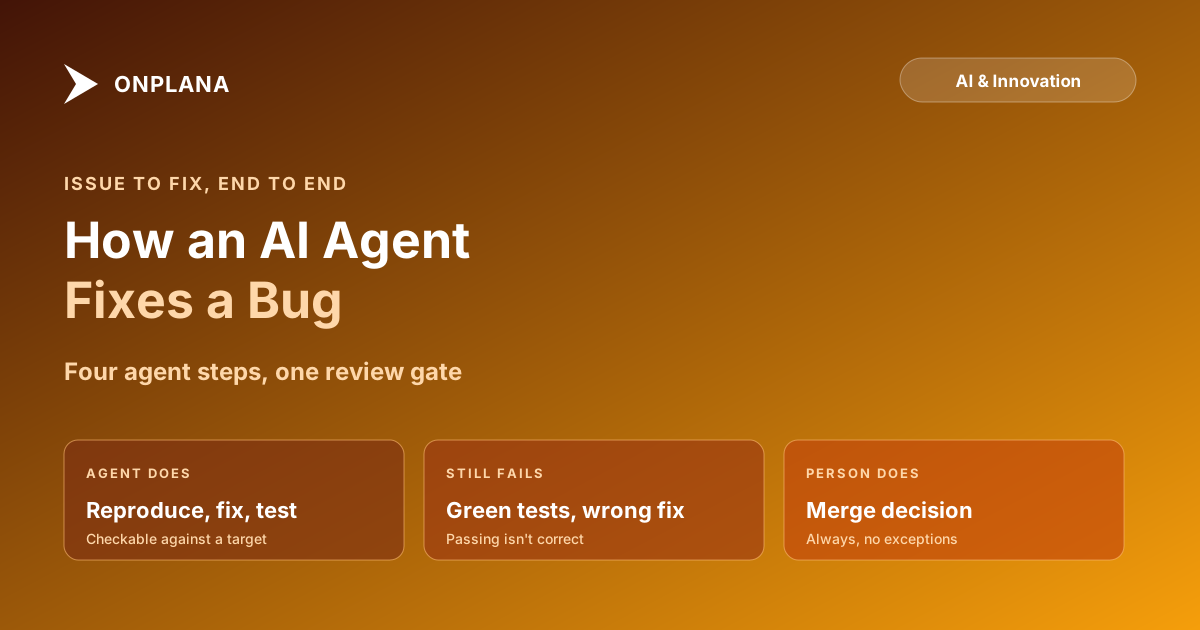
How an AI Agent Fixes a Bug End to End
An AI agent fixing a bug end to end can reproduce it, propose a change, and open it for review. It should never decide the fix is the right one alone.
Most descriptions of "AI agents that fix bugs" quietly compress a four-step loop into one confident sentence, and the missing steps are exactly where a team either builds something they trust or ships something they have to walk back.
The direct answer: an AI agent can fix a bug end to end through investigation, reproduction, the fix itself, and the tests that prove it, run without a person touching any of those four steps. What it shouldn't do is the step after that: deciding the fix is the right one and merging it unattended. Reproducing a bug and passing a test suite are both checkable against a target that already exists. Deciding a fix is correct is a judgment call about intent, and that call is the one step in the loop worth keeping a person on, every time, not just on the cases that look uncertain.
An agent can own the full mechanical loop from an issue to a proposed fix: reproduce, investigate, write the change, run the tests, and open it for review. The loop should stop there. Merging is a judgment call about whether the fix is right, not just whether it works, and a passing test suite checks the behavior someone already thought to test for, not whether the agent understood the actual problem. Staff review capacity for the volume an agent can generate, not the volume a team produces today, since the review step is the one part of this loop that doesn't get faster on its own.
How an AI Agent Fixes a Bug End to End: Four Steps, One Gate
The version of this that holds up in practice has a specific shape: an issue arrives, an agent reproduces it from the reported steps, proposes a change with the tests that pass against it, and stops at a pull request rather than a merge. AI agent issue triage covers the front half of this same loop in isolation, reproduction, duplicate matching, and severity, and stops deliberately before a fix exists at all. This post picks up from there: once triage has confirmed a real, reproducible issue, the same reproduction becomes the seed for a proposed fix, and the same principle about a checkable target holds all the way through drafting the change.
What the Agent Owns, Step by Step
- Reproduce the issue from the reported steps. Pass, fail, or can't reproduce, a binary outcome checkable against the report itself.
- Investigate the failing path. Trace the code from the reproduction to the point where behavior diverges from what the issue describes as expected.
- Draft the fix. Propose a change scoped to the failing path, not a broader refactor the issue didn't ask for.
- Write and run the tests that prove it. A new test that fails before the fix and passes after is stronger evidence than a fix with no test attached to it at all.
Every one of these four steps has a target that already exists, either the reproduction succeeds or it doesn't, either the new test goes from red to green or it doesn't. AI agents in software development covers why that structural feature is what makes a stage suitable for an agent in the first place: a checkable target rewards fast, mechanical work, and none of these four steps require the agent to decide whether the underlying goal is the right one.
The One Step That Stays With a Person
Deciding a fix is correct isn't the same kind of check as deciding a test passes. A fix can satisfy every existing test and still solve the wrong problem, patching the symptom described in the issue while leaving the actual defect in place, because the test suite only checks the behavior someone already thought to write a test for. Reviewing AI-generated work covers the same asymmetry from the review side: the failure that survives a skim is the one dressed as a normal, complete-looking outcome, and a green test run on a plausible diff is exactly that kind of outcome. The reviewer's job on an agent-opened pull request isn't confirming the tests pass; it's confirming the fix matches what the issue actually needed, which sometimes means recognizing that the right fix lives one layer upstream of the symptom that got reported.
| Step | Agent does this | A person does this |
|---|---|---|
| Reproduce from reported steps | Yes: pass, fail, or can't reproduce | Reviews only if the agent can't reproduce |
| Investigate the failing path | Yes: traces to the point of divergence | Confirms the trace if the path is ambiguous |
| Draft the fix | Yes: scoped to the failing path | Judges whether the fix addresses the real cause |
| Write and run tests | Yes: red-before, green-after | Checks the test actually covers the reported case |
| Merge the change | No | Always, regardless of how clean the diff looks |
The diagram below shows the same loop as a cycle: four agent-owned steps feeding into one review gate that always routes back to a person.
Staffing for the Volume, Not the Steady State
The mechanical steps scale with however many agents a team runs in parallel: an agent can reproduce and draft fixes for a dozen issues in the time a person handles one. The review gate doesn't scale the same way, because judging whether a fix matches the actual intent behind an issue takes roughly the same attention per pull request whether it came from an agent or a person. Who is accountable when an agent is wrong covers what happens when a team lets review capacity lag behind agent throughput: the accountability for a bad merge doesn't move, it just lands on a reviewer who had less time per pull request than the gate assumed they'd have.
Wiring this loop into a real issue log matters more than the fix-generation step itself, since the loop only works end to end if the agent's reproduction, the resulting pull request, and the review decision all trace back to the same issue record instead of living in three disconnected tools. The rest of the Onplana blog's AI and Innovation coverage goes further into the permission and review-gate design a loop like this needs before an agent gets anywhere near a merge button on real code.
Frequently asked questions
Can an AI agent fix a bug end to end without a person in the loop?
It can run every mechanical step, reproduce the issue, write a fix, run the tests, open it for review, without a person touching any of them. It should not be allowed to merge that fix itself. The loop ends at a review gate, not at a passing test suite.
What does 'end to end' actually mean if a person still has to approve it?
It means the agent owns every step between the issue arriving and a mergeable change existing, investigation, reproduction, the fix itself, and the tests that prove it. What it doesn't own is the last step, deciding the fix is the right one, which is a judgment call about intent rather than a check against a target.
Can an agent destroy something irreversible while investigating a bug on its own?
Yes, if its access isn't scoped to stop it, running a destructive migration, deploying straight to production, or force-pushing over history are all technically reachable from the same credentials that let it read the code. The fix is denying those specific actions by default regardless of how confident the proposed change looks, not trusting a clean diff as a proxy for safe access.
Who is accountable if an agent's merged fix breaks something downstream?
The person who reviewed and approved the merge, exactly as if a human teammate had opened the same pull request. An agent doesn't introduce a new category of accountability; it just means more pull requests arrive at the same review gate, which is why that gate has to hold at agent speed instead of relaxing under volume.
Can a misleading issue description steer an agent toward the wrong fix?
Yes. An agent reads an issue's title and description as content it weighs, not a verified account of the actual defect, so a report that frames a symptom as the cause can produce a fix that patches the symptom and leaves the real bug in place. Weight what the reproduction actually shows over how the issue happened to be worded.
What happens to the review queue if agent-opened fixes triple in a week?
The investigation and fix-drafting steps scale with however many agents you run in parallel, but the human review step doesn't get faster because more pull requests arrived. Staff or schedule review capacity for the volume you expect an agent to generate, not just the volume a team produces today, or the queue backs up at the one gate meant to hold.
Can the fix an agent proposes be wrong even when every test passes?
Yes, and this is the failure mode worth watching hardest. A fix can satisfy every existing test and still solve the wrong problem, because the test suite checks the behavior someone already thought to write a test for, not whether the agent understood what the issue was actually asking for. A green test run is evidence, not a verdict.
Where does an agent fall short in this loop?
Deciding whether the underlying issue should be fixed the way it was filed at all: sometimes the right fix is a design change upstream of the reported symptom, and recognizing that requires judgment about intent that a reproduction step can't supply. An agent optimizes for the issue as written; a person still has to ask whether the issue was framed correctly in the first place.
Ready to make the switch?
Start your free Onplana account and import your existing projects in minutes.