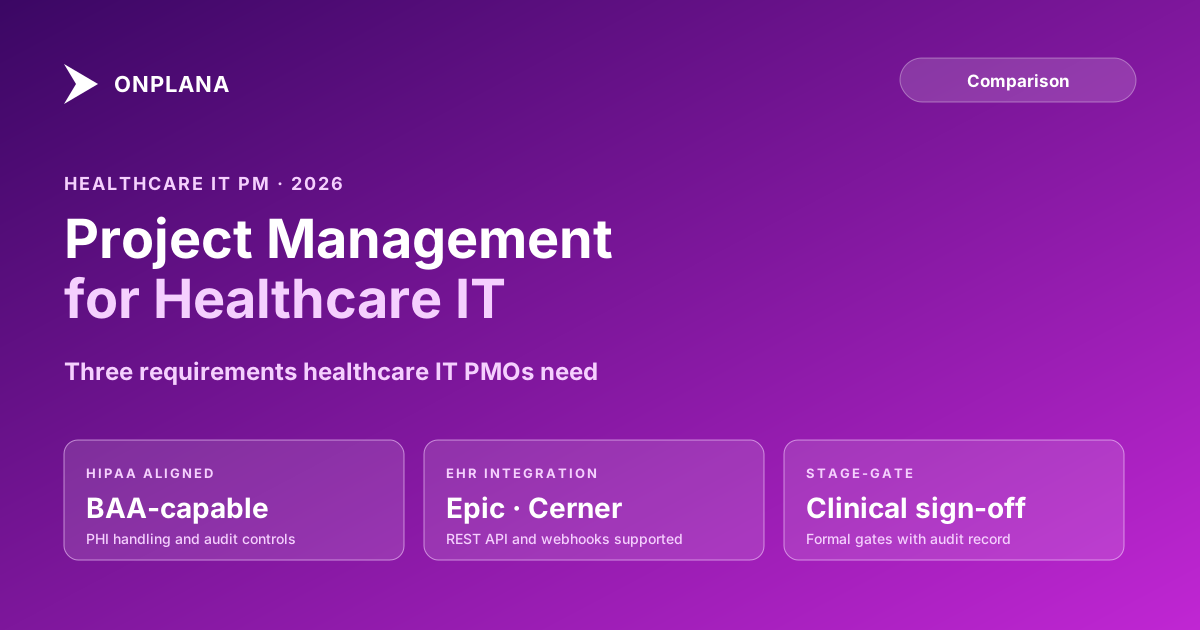
Project Management for Healthcare IT: Tool Selection Guide
Evaluating healthcare IT project management tools? This guide covers HIPAA alignment, EHR implementation, audit trails, and governance for health system PMOs.
Healthcare IT project management exists at the boundary between two disciplines that do not naturally speak to each other. Clinical operations measures success in patient outcomes, care quality, and workflow efficiency. IT project delivery measures success in schedule adherence, budget, and scope completeness. An EHR implementation project, an Epic go-live, a clinical data migration, touches both. The PM sits in the middle, translating between them, and the tools they use need to handle the complexity of both.
Generic project management software, the kind built for software delivery teams or cross-functional business projects, does not handle this well. It lacks the resource planning depth for multi-workstream healthcare implementations, the governance model for clinical phase approvals, and the audit capability that healthcare IT organizations expect from any system they adopt. Teams use it anyway, then build compensating processes in spreadsheets, SharePoint pages, and recurring status meetings.
This guide covers what healthcare IT PMOs should require from PM software, why the evaluation criteria differ from general IT organizations, and where common tool categories succeed and fail.
TL;DR. Healthcare IT project management software must handle multi-workstream resource planning, formal stage-gate governance with clinical sign-off, audit trails for regulated IT environments, and deployment flexibility for health systems with strict data residency policies. The most complex healthcare IT projects, Epic implementations and enterprise EHR migrations, need a platform built for PMO depth, not a task coordination tool. Assess your PMO's current governance and resource planning maturity with the free PMO Maturity Assessment.
Why Healthcare IT PM Is a Distinct Discipline
Healthcare IT projects are IT projects, but with a set of constraints that change the management model in material ways.
Clinical stake in delivery. A software delivery delay in a commercial organization creates a business impact. A go-live delay in a health system can affect patient care scheduling, billing systems, and clinical workflow in ways that touch patient outcomes directly. The go-live risk is not abstract. Epic implementations that go live on a poorly tested build create nursing workflow problems that manifest as overtime, workarounds, and sometimes adverse event risks. This means clinical leadership has a governance stake in the project that most IT projects do not face.
Scale and parallelism. An enterprise EHR implementation involves hundreds of build workstreams running concurrently: registration, scheduling, clinical documentation, medication management, order management, laboratory, radiology, revenue cycle, and dozens of others. Each workstream has its own timeline, its own team, its own testing phases, and its own go-live dependencies. The PM platform needs to handle this at portfolio scale, not as a single project.
Regulatory and compliance context. Health systems are covered entities under HIPAA. Any vendor that receives access to PHI in the course of the project must sign a Business Associate Agreement. Even if the PM tool does not process PHI directly, the healthcare IT PMO must operate in a compliance culture that expects auditability, access controls, and documented change management for any system involved in regulated activities.
Training and change management at scale. A large Epic implementation trains thousands of clinical staff. Training delivery, attestation tracking, and go-live readiness assessment are project management activities at a scale and format most general PM tools were not designed for. They typically live in a separate LMS or training management system, but the PM platform needs to track training completion milestones as go-live dependencies.
HIPAA Compliance: What PM Tools Actually Need to Handle
For a vendor-by-vendor view of which tools document a BAA and on which plan, see our ranking of the best project management software for healthcare.
HIPAA applies to healthcare IT PM tools in two ways, and it is worth being precise about each.
PHI in the PM tool itself. If team members enter patient information into the PM tool, even incidentally, in issue descriptions, meeting notes, or task comments, the tool becomes a PHI repository and the vendor becomes a Business Associate. Most PM platforms are not designed for this and are not built to meet HIPAA's technical safeguard requirements for PHI storage. Healthcare IT PMOs should establish a clear policy: the PM tool is for project management data, not for patient data. Clinical scenarios, test cases, or go-live support tickets that involve patient identifiers belong in a separate, PHI-appropriate system.
BAA availability. Even if the PM tool does not process PHI, health systems often require Business Associate Agreements with all technology vendors as an organizational policy. The PM tool vendor should be willing to sign a BAA. Many SMB and startup PM vendors are not. Enterprise PM platforms and self-hosted options can typically accommodate BAA requirements.
The HHS guidance on HIPAA compliance defines the technical and administrative safeguard requirements. For a healthcare IT PMO evaluating PM software, the relevant questions are: will the vendor sign a BAA, does the platform have role-based access controls, are audit logs available for access events, and does the hosting model satisfy the health system's data residency policy?
Self-hosted deployment is the cleanest answer to data residency requirements. When the PM platform runs within the health system's own cloud account or data center, the PHI-handling policy is straightforwardly clear: PM data stays inside the perimeter.
EHR Implementations: The Complexity That Defines the Category
Epic and Oracle Health implementations represent the most complex project management challenges in healthcare IT. Understanding their structure clarifies why the tool requirements are different from standard IT projects.
A mid-size health system Epic implementation typically involves:
- 18 to 36 months of project duration from kickoff to go-live
- 50 to 200 project team members at peak, across Epic analysts, clinical informatics staff, trainers, and interface engineers
- Hundreds of concurrent build workstreams, each with their own test cycle and sign-off requirements
- Multiple rounds of integrated testing (Unit Test, System Integration Test, User Acceptance Test) with formal exit criteria
- A training program covering thousands of clinical users across multiple sites
- Interface builds connecting Epic to ancillary systems (lab, radiology, pharmacy, payroll, billing)
- A go-live event that often involves 24-hour command center coverage
The PM platform needs to handle resource planning at this scale. A resource assigned to three concurrent build workstreams in week 14 of the project may not have visible capacity for a fourth workstream that month. The PM platform must surface this before the assignment is made, not after the overallocation is already causing delivery slippage.
The diagram below shows the major phases of an Epic implementation and the dependency structure between them.
Each gate in the diagram requires documented approval from both IT and clinical leadership before the next phase begins. PM tools that track gates only as task milestones, without an approval workflow that routes to designated signatories and produces a record, cannot enforce this governance model. Onplana's enterprise project governance pipeline handles stage-gate approvals natively, with formal sign-off routing and an auditable gate record. The approval stays in email, the audit trail stays in someone's inbox, and the sign-off record is not accessible when the project comes up for post-implementation review.
Audit Trails and Change Control in Healthcare IT
Healthcare IT organizations operate with a compliance culture that expects documented change management, not because their PM tools are formally regulated, but because the adjacent systems (EHR platforms, clinical data systems, billing systems) are. That culture extends to how projects are managed.
Specifically, healthcare IT PMOs should expect PM software to:
- Log all changes to schedule data with timestamp and user identity
- Retain change history indefinitely or according to the organization's record retention policy
- Support access control that restricts who can modify baselines versus who can read them
- Allow formal change request workflows for scope changes, with a documented approver chain
- Produce reports for change history on specific project records for post-implementation reviews or audit requests
These are not exotic requirements. They are standard capabilities in enterprise PM platforms and absent in most general-purpose task management tools.
Resource Management for Healthcare IT Teams
Multi-workstream EHR implementation projects require resource planning at a scale that single-project views cannot handle. The Epic analyst who manages the Revenue Cycle workstream may also be supporting the Reporting workstream in months 6 through 9. The clinical informatics specialist is in go-live command center coverage for Health System A while training sessions for Health System B begin. The PM platform must surface these conflicts before they become delivery problems.
Healthcare IT PMOs should look for:
- An enterprise resource pool that stores named resources with their roles, available hours, and skill tags
- Cross-project resource loading reports that show each person's total committed hours across all active workstreams and projects
- Conflict detection when a new assignment would push a resource over capacity
- The ability to model contractor and vendor resources alongside internal staff
The security and compliance overview is relevant for healthcare IT PMOs evaluating how PM platforms handle access controls, audit logs, and compliance posture: the same dimensions that matter for clinical system procurement apply here.
Healthcare IT PM Tool Comparison
The table below compares three common approaches for healthcare IT PMO tooling.
| Dimension | Generic PM tools (Asana, Monday) | ServiceNow PM module | Onplana |
|---|---|---|---|
| Multi-workstream resource planning | Basic per-project | ITSM-integrated resource mgmt | Enterprise resource pool, cross-project |
| Stage-gate governance | No | Configurable approvals | 12-stage governance pipeline |
| Audit trail | Limited | Full ServiceNow audit log | Full audit trail |
| BAA availability | Varies by vendor | Yes (enterprise) | Yes (enterprise tier) |
| EHR system integration | Via third-party | ServiceNow native connectors | REST API + webhooks |
| Self-hosted deployment | No | On-premise available | AWS, Azure, GCP, Docker |
| Pricing | $10-25/user/month | $100+/user/month | Free to $29/user/month |
| Learning curve | Low | High (ITSM mindset) | Moderate |
ServiceNow's project module is powerful and integrates well with IT service management data, but it carries a pricing structure and learning curve that is difficult to justify for healthcare IT PMOs whose primary need is project scheduling and resource management rather than ITSM workflow integration. It also tends to be IT-centric in its governance model, which creates friction with the clinical sign-off requirements that healthcare IT projects need.
Generic PM tools are accessible and low-cost, but they fail on the two criteria that matter most for healthcare IT: multi-workstream resource planning and formal governance with clinical approval workflows.
A modern PM platform built for PMO depth, with enterprise resource management, stage-gate governance, API integration, and self-hosted deployment options, covers the requirements without the ServiceNow pricing or the ITSM overhead. For healthcare IT PMOs evaluating their current platform maturity, the PMO Maturity Assessment provides a structured baseline across governance, resource planning, reporting, and compliance dimensions.
Run the free PMO Maturity Assessment Assess your healthcare IT PMO's current governance, resource planning, and compliance capabilities in about 10 minutes. Identifies the gaps most likely to affect your next EHR implementation or migration project. No signup required. Open the PMO Maturity Assessment
Frequently asked questions
What makes healthcare IT project management different from general IT project management?
Healthcare IT projects handle PHI, operate under HIPAA and state privacy regulations, often require ONC certification alignment, and must maintain audit trails for regulatory purposes. EHR implementation projects also involve clinical workflow design, staff training at scale, and go-live risk that has direct patient care implications. These constraints change both the tool requirements and the governance model.
Does a PM tool used in healthcare IT need to be HIPAA compliant?
If the PM tool stores or processes Protected Health Information (PHI), it becomes subject to HIPAA Business Associate Agreement requirements. Most project management platforms do not handle PHI directly; the PHI stays in the EHR system. However, issues logs, meeting notes, and implementation documents can inadvertently include PHI if the team is not careful about data hygiene. Healthcare IT PMOs should establish clear policies about what data goes into the PM tool.
What are the most complex healthcare IT projects to manage?
Epic and Oracle Health (formerly Cerner) implementations are typically the most complex: they involve hundreds of build workstreams, thousands of training hours, clinical workflow redesign, interface builds, data migration, and a go-live event with zero tolerance for unplanned downtime. Enterprise-wide EHR migrations can run 2-4 years and involve hundreds of stakeholders across clinical, IT, finance, and operations departments.
How many resources does a typical Epic implementation require?
A mid-size health system Epic implementation typically involves 50 to 200 project team members at peak, spanning Epic analysts, clinical informatics staff, trainers, interface engineers, and executive sponsors. Resource planning across these workstreams requires a portfolio-level view that single-project PM tools cannot provide.
What governance model works best for EHR implementation projects?
Stage-gate governance with formal clinical sign-off at each major phase: project initiation, build, testing, training, and go-live. Each gate should require documented approval from both IT leadership and clinical leadership before the next phase begins. This is different from typical IT governance because clinical sign-off carries weight that operational go-live decisions depend on.
Can Onplana support a healthcare IT PMO?
Onplana's enterprise resource pool handles multi-workstream resource planning, stage-gate workflows enforce formal phase approvals, and self-hosted deployment keeps PM data within the organization's own infrastructure, satisfying data residency requirements for health systems with strict IT policies. The audit trail records all schedule and assignment changes.
Ready to make the switch?
Start your free Onplana account and import your existing projects in minutes.