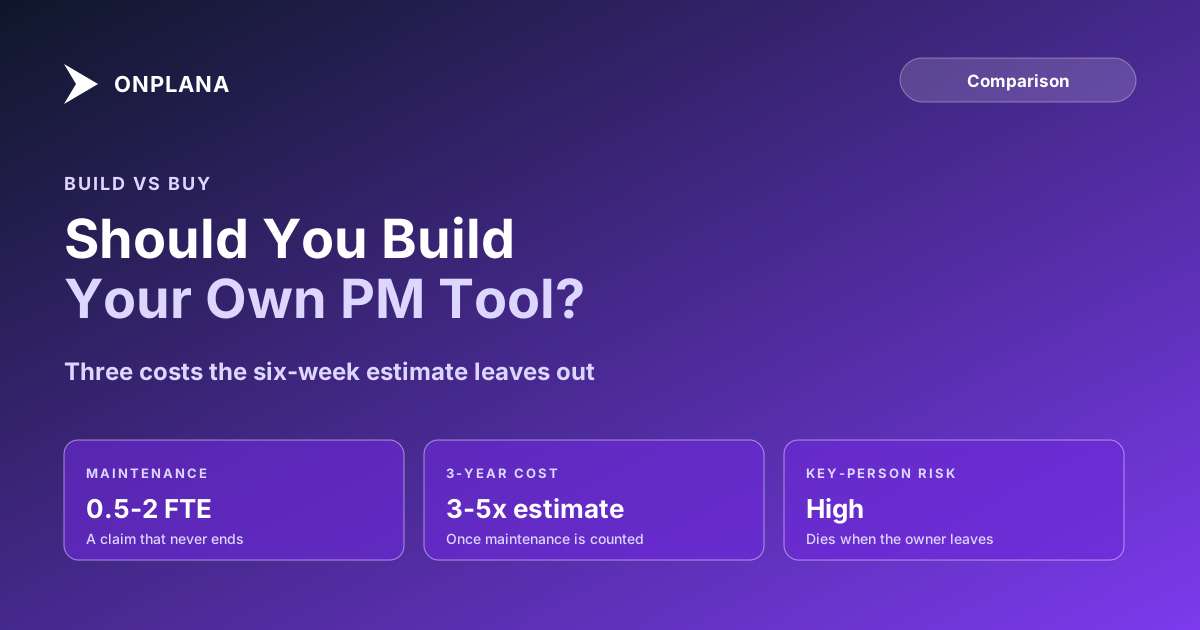
Build vs Buy Project Management: The Real Cost
Build vs buy project management tooling rarely favors build: the license fee is visible, the maintenance headcount is not, and it never goes away.
Every few years, someone on the engineering team looks at the PM tool's invoice and asks a version of the same question: why are we paying per seat for something a couple of sprints could build ourselves?
Build vs buy project management decisions favor buying in almost every case, because the sticker price is the only cost the build pitch actually counts. The license fee shows up on an invoice; the engineering time to build and then permanently maintain dependencies, resource leveling, baselines, and reporting shows up nowhere until it's already been spent.
The short version A vendor's per-seat price is visible; the engineering hours to build and maintain an equivalent tool are not, and they never stop accruing. Building is defensible only when the gap is core to a workflow no vendor sells and a team will own it permanently. Most PMOs that build end up buying within two to three years anyway, after re-learning why the vendor's roadmap existed.
Why Building Sounds Cheap
The build pitch always starts with the same math: two engineers, six weeks, a task board with drag-and-drop and a Kanban view. This is a version of the classic make-or-buy decision every operations function eventually faces, the same outsourcing tradeoff applied to internal tooling instead of manufacturing or IT infrastructure. That estimate is usually accurate, and it's also answering the wrong question. A Kanban clone is not a PM tool. The vendor you're comparing against also ships dependency types with lag, resource leveling that respects those dependencies, baselines you can diff against the live schedule, permission-level governance, and an integration surface. None of that is in the six-week estimate, because nobody scoped it.
Build vs Buy Project Management: The Cost Comparison
| Dimension | Build in-house | Buy |
|---|---|---|
| Upfront cost | Engineer time, feels free because it's already on payroll | License fee, itemized and visible from day one |
| Time to a usable tool | Months for a bare version, years to match a mature vendor | Live the same day |
| Feature completeness | Ships with whatever the first sprint scoped, nothing more | Dependencies, leveling, baselines, reporting already built |
| Ongoing maintenance | A permanent 0.5-2 FTE claim that never goes away | The vendor's problem, priced into the seat fee |
| Security and compliance | You build SSO, audit logs, and SOC 2 readiness from scratch | Usually already certified |
| Key-person risk | High: the tool degrades the day its one maintainer leaves | Low: a support contract survives staff turnover |
| Feature backlog | Every PM request becomes an engineering ticket, indefinitely | Absorbed into the vendor's roadmap at no marginal cost |
| Three-year total cost | Frequently three to five times the six-week estimate | A predictable per-seat line item |
The pattern in that table is not that building is impossible. It's that the visible cost of building (a fixed sprint estimate) and the real cost of building (an open-ended maintenance claim) are different numbers, and only one of them made it into the original pitch.
When Building Is Actually Defensible
Building is the right call in a narrower set of conditions than most build pitches admit. It's defensible when the capability is genuinely core to a competitive workflow, something no vendor sells because it's specific to how your organization delivers work, and you have engineers who will own it as a real product with a backlog and an on-call rotation, not a side project that quietly stops getting updated after the person who built it moves teams. A construction firm building a custom takeoff-to-schedule pipeline that ties directly into proprietary estimating software is a real case. A PMO building its own Gantt chart because the vendor's per-seat price feels high is not; that gap is exactly what the market already solved.
The diagram below walks through the decision in the order that actually matters: whether a vendor covers the need, then whether the remaining gap is core enough to justify a permanent engineering commitment.
The Opportunity Cost No One Puts in the Spreadsheet
The line item that never appears in a build pitch is what those engineers would otherwise ship. A PMO tool is not the product a software company sells; every sprint spent on internal tooling is a sprint not spent on the thing customers pay for. That's true even when the headcount is "free" because it's already on payroll: the opportunity cost is the same whether the invoice is explicit or invisible. Onplana's Starter tier runs seven dollars per seat per month for 25 members and 25 projects; a 25-person PMO on that plan spends less in a year than two weeks of one senior engineer's fully loaded cost, before that engineer has written a single feature.
None of this means every internal tool is a mistake. It means the build decision has to survive the same PM tool evaluation criteria you'd apply to a vendor, scored against a real maintenance commitment, not a six-week demo estimate. If the honest answer is that nobody has volunteered to own the tool three years from now, that's the answer to the build vs buy question too. For the fuller cost model once you've decided to buy, see the true total cost of ownership of a PM tool, and if self-hosting specifically is on the table, the real total cost of self-hosted PM tools runs the same exercise for that middle path.
Frequently asked questions
When does it make sense to build a PM tool in-house?
Only when the gap you need is genuinely core to a competitive workflow no vendor sells, and you have engineers who will own it as a permanent product, not a side project. For general scheduling, resourcing, and reporting, buying is cheaper almost every time.
What's the real cost of building a PM tool in-house?
Beyond the initial build, count a permanent 0.5-2 FTE maintenance claim, the security and compliance work a vendor already did, and every future feature request landing on your engineering backlog instead of a vendor's roadmap.
How long does it take to build a competitive project management tool?
A bare task board takes weeks. Matching what a mature vendor ships out of the box, dependency types, resource leveling, baselines, reporting, and permissions, typically takes six months to two years of sustained engineering time, not a sprint or two.
Can we build a small internal tool now and switch to buying later?
You can, but budget for the switch: whatever the internal tool becomes the system of record for has to be re-migrated, and the team has to retrain again. It's often cheaper to buy a flexible tool from day one than to buy twice.
Ready to make the switch?
Start your free Onplana account and import your existing projects in minutes.