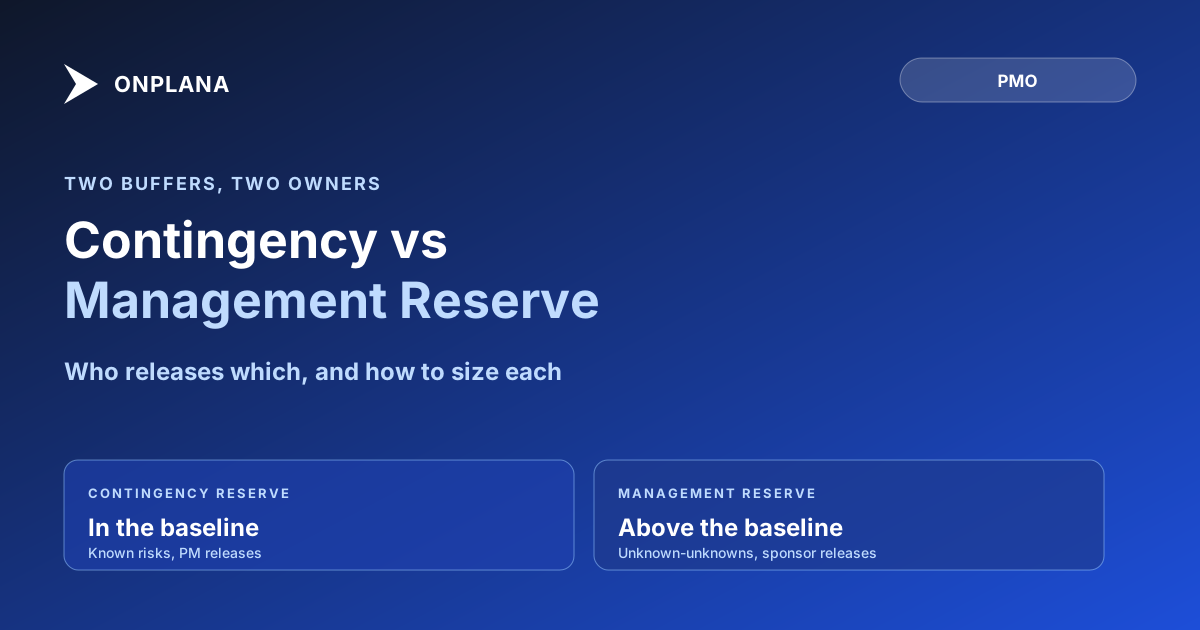
Contingency Reserve vs Management Reserve: Who Owns Which
Contingency reserve vs management reserve: one is inside the cost baseline and the PM releases it, the other sits above it and needs a sponsor's sign-off.
The direct answer: contingency reserve covers known risks identified in the risk register, sits inside the approved cost baseline, and the PM can release it without a change request. Management reserve covers unknown-unknowns nobody identified in advance, sits above the cost baseline as part of overall project funding, and needs a sponsor's or change control board's formal approval to release. Spend either one down without tracking which pot it came from, and the project loses the ability to answer a basic finance question: how much true contingency is actually left.
Ask a PM where the contingency reserve line item is and most can point to it. Ask where the management reserve is, and how much of it is left, and the answer gets vague fast, usually because both numbers were folded into a single "buffer" line during budgeting and nobody has tracked them separately since. That's the mistake: contingency reserve vs management reserve isn't a naming preference, it's two pots with different owners, different triggers, and different accounting treatment, and treating them as one pot means neither gets managed correctly.
Contingency reserve is for known risks in the risk register, is part of the cost baseline, and the PM releases it directly. Management reserve is for unknown-unknowns, sits outside the cost baseline as part of total project funding, and only a sponsor or governance body can release it through a formal change request. Size contingency reserve from the risk register (expected monetary value or a Monte Carlo run); size management reserve as a percentage of total budget set by organizational risk tolerance. Track them as two separate numbers, not one buffer line, or a finance review can't tell you how much real contingency is left.
Contingency Reserve: Known Risks, PM-Owned
Contingency reserve exists for risks the team already identified and analyzed during risk planning: a vendor that historically slips delivery dates, a permit that sometimes takes longer than scheduled, an integration with a known history of rework. Each of these is a named line in the risk register with a probability and a cost impact attached, and contingency reserve is the money or time set aside specifically to absorb them if they fire.
Because these risks were already accounted for when the budget was baselined, contingency reserve is part of the approved cost baseline itself. That has a direct consequence for who can spend it: the PM releases contingency reserve when one of the risks it was sized for actually occurs, without routing a change request through the sponsor, because the spend was already planned and approved as part of the baseline. What the PM should not do is spend contingency reserve on a problem that wasn't in the risk register it was sized against; that's a management reserve situation instead, even if the dollar amount looks similar.
Management Reserve: Unknown-Unknowns, Sponsor-Owned
Management reserve exists for the risks nobody identified: the kind of problem that shows up specifically because it wasn't anticipated. A regulatory change mid-project, a key vendor going out of business, a scope discovery nobody could have planned for. Because these are unknown by definition, management reserve isn't derived from the risk register the way contingency reserve is; it's typically set as a percentage of the total project budget, sized to the project's overall estimate uncertainty and the organization's appetite for that uncertainty.
The accounting treatment is the structural difference that matters most: management reserve sits outside the cost baseline, as part of the project's total funding requirement rather than its approved spend plan, a distinction project finance guidance is explicit about. Releasing it requires a formal change request to the sponsor or a change control board, and once approved, that specific amount moves into the cost baseline going forward. This is why management reserve isn't a PM-level decision: spending it changes the baseline itself, which is a governance action, not a schedule action.
The diagram below shows where each reserve sits relative to the cost baseline, since that placement is what drives who can release which one.
Contingency Reserve vs Management Reserve: Side by Side
| Dimension | Contingency Reserve | Management Reserve |
|---|---|---|
| Covers | Known risks, already in the risk register | Unknown-unknowns, not identified in advance |
| Part of the cost baseline? | Yes | No, sits above it as part of total funding |
| Who releases it | The PM | The sponsor or a change control board |
| How it's released | Directly, when the identified risk fires | Via a formal change request |
| Sizing method | Expected monetary value from the risk register, or a Monte Carlo simulation | A percentage of total project budget, set by risk tolerance |
| Effect on the baseline | None, it was already in the baseline | Moves into the baseline once released |
| Typical owner of the sizing decision | Project manager, during risk planning | Sponsor or PMO, during budget approval |
A Worked Sizing Example With Real Numbers
Take a project with $2,000,000 of planned work and three named risks in the register. Contingency reserve is the sum of each risk's probability times its cost impact, the expected monetary value:
| Risk in the register | Probability | Cost impact | Expected value |
|---|---|---|---|
| Vendor delivery slips | 30% | $120,000 | $36,000 |
| Permit takes longer than scheduled | 20% | $150,000 | $30,000 |
| Integration needs rework | 40% | $90,000 | $36,000 |
| Contingency reserve | $102,000 |
The cost baseline is $2,000,000 plus $102,000, so $2,102,000. The sponsor's policy sets management reserve at 5 percent of that baseline: $105,100. Total funding is $2,207,100, and only $2,102,000 of it is the baseline the PM manages against. If the vendor slips, the PM draws from the $102,000 without a change request. If a regulator changes the rules mid-project, nothing in the register covers it, and the sponsor must approve a change request to move money out of the $105,100 into the baseline. The figures are illustrative; the structure is the point.
Sizing Each Reserve So It Survives a Finance Review
A finance reviewer's first question about any reserve line is "how did you get that number," and "we added 10 percent to be safe" doesn't survive that question for either reserve, for different reasons.
For contingency reserve, the defensible method starts from the risk register: take each risk's probability and multiply it by its cost impact to get its expected monetary value, then sum the expected monetary values for the risks the reserve is meant to cover. A more rigorous version runs a Monte Carlo simulation across the full cost and schedule model, producing a distribution rather than a single number, and lets the organization pick a confidence level, commonly the 80th percentile, to size the reserve against. Either way, the number traces back to specific, named risks, which is exactly what a reviewer wants to see.
For management reserve, the defensible method looks different because there's no risk register to derive it from; the reserve exists for what the register can't see. The standard approach sizes it as a percentage of total project budget, commonly landing in the single digits up to around 10 percent, set deliberately by the sponsor or PMO based on the project's overall estimate maturity and the organization's documented risk appetite. What doesn't survive review is picking that percentage after the fact to make a budget balance; the percentage needs to be a stated policy, applied consistently, not a plug figure.
The schedule has its own version of this split, covered in where buffer belongs in a project schedule, where project buffer plays the role contingency plays in the budget.
The Two Traps That Break Both Reserves
The first trap is combining them into one line item. Once contingency and management reserve share a single number, nobody can answer "how much of our true contingency is left" without unpacking which withdrawals came from which pot, and PMs under schedule pressure reliably start treating the combined pot as PM-releasable, quietly spending money that should have required a change request.
The second trap is releasing management reserve without updating the baseline. Because management reserve sits outside the cost baseline until it's formally released, skipping that update step means the project's reported baseline understates what's actually been approved, and the next earned value calculation runs against a baseline that no longer matches reality. The same discipline that keeps a schedule buffer separate from the tasks it protects applies here: a reserve only works if its boundary is enforced, not just documented.
Getting the budget-vs-schedule tradeoff right depends on this same discipline, since a PM weighing whether to spend money to protect a date needs to know which pot that money is actually coming from before making the call. For the fuller risk-planning context both reserves sit inside, see the project risk management guide.
What happens next for most PMOs running this split for the first time: audit the current budget for a single merged "contingency/buffer" line, split it into its known-risk and unknown-unknown components using the sizing methods above, and set the release-authority rule (PM for contingency, sponsor for management reserve) in writing before the next reserve gets spent. The rest of the Onplana blog covers the wider PMO practice these two reserves sit inside, from baselines to the risk register they're sized against.
Frequently asked questions
What is the difference between contingency reserve and management reserve?
Contingency reserve covers known risks already identified in the risk register and sits inside the approved cost baseline; the PM can release it without a change request. Management reserve covers unknown-unknowns that no one identified in advance, sits above the cost baseline, and needs a sponsor's or governance body's sign-off to release.
Who releases contingency reserve?
The project manager, generally without a formal change request, because contingency reserve is already part of the approved cost baseline and was set aside for exactly this category of known risk.
Who releases management reserve?
The sponsor or a governance body such as a change control board, through a formal change request. Releasing it moves the amount into the cost baseline and increases the project's approved budget, which is why it isn't a PM-level decision.
How do you size a contingency reserve?
From the risk register itself: multiply each identified risk's probability by its cost impact (expected monetary value) and sum across the risks the reserve is meant to cover, or run a Monte Carlo simulation across the schedule and cost model for a distribution-based estimate. Either method ties the number to specific, named risks rather than a flat percentage.
How do you size a management reserve?
As a percentage of the total project budget, commonly in the single digits to around 10 percent, set by the sponsor or PMO based on the project's overall estimate uncertainty and the organization's risk tolerance. Because it exists for unknown-unknowns, it isn't derived from the risk register the way contingency reserve is.
Is management reserve part of the project budget?
Yes, but not part of the cost baseline. It's part of the total project funding requirement, held above the baseline until a change request pulls a specific amount into it, at which point that amount becomes part of the baseline going forward.
Ready to make the switch?
Start your free Onplana account and import your existing projects in minutes.