Cone of Uncertainty: Why Early Project Estimates Are Wrong
The cone of uncertainty says an early estimate can be off by 4x high or 0.25x low, a predictable range that narrows as the project moves through each phase.
The cone of uncertainty is a model, first used by cost engineers in the 1950s and brought into software by Barry Boehm, that says an estimate made at the start of a project can be wrong by a factor of four in either direction, and that this isn't a sign of bad estimating. Steve McConnell named it "the cone of uncertainty" in 1997, formalizing a pattern Boehm had already validated against real Air Force and NASA project data: the error at the earliest phase is structural, not personal, and it shrinks in predictable steps as the project answers specific questions, not as the calendar advances.
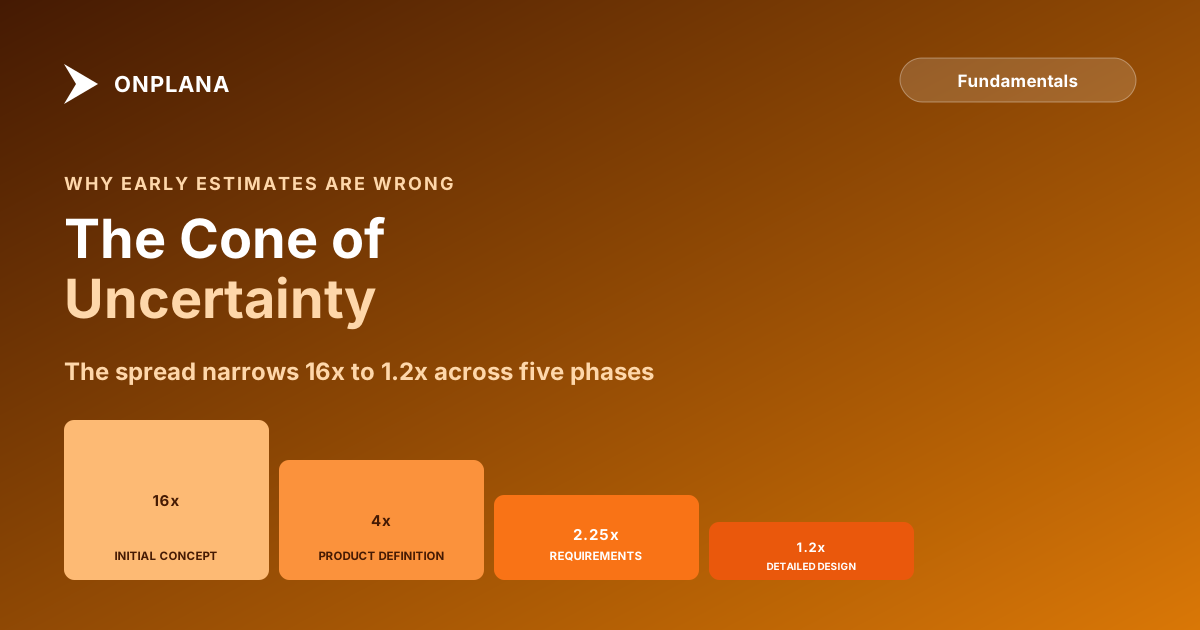
The direct answer: at Initial Concept, before scope is defined, an honest estimate can run 4x high or 0.25x low, a 16x spread between the best and worst case. That range narrows to roughly 0.8x to 1.25x by the time the user interface design is complete, and to about 0.9x to 1.1x once detailed design is finished. The narrowing tracks decisions made, not days elapsed.
In short. A single number given early in a project isn't a bad estimate; it's an honest estimate reported without its cone. The fix isn't a better guess, it's a stated range tied to the phase the estimate was made in, updated as the project answers the specific questions that narrow the range.
What Is the Cone of Uncertainty?
The concept predates software entirely. Cost engineers in the chemical and construction industries built the first version of it in 1958 to describe how a project's cost estimate tightens as design work progresses. Barry Boehm brought the idea into software estimation, calling it the "Funnel Curve," and validated the shape against data from Air Force software projects and NASA's Software Engineering Lab. McConnell's contribution was the name that stuck and the phase-by-phase table most estimators actually use.
The core claim is narrow and specific: uncertainty in a project estimate isn't uniform across the project's life. It's largest at the very beginning, when the scope itself is still being defined, and it narrows as specific unknowns get resolved, requirements agreed, interfaces designed, technical approach settled. A team that treats a Day 1 estimate with the same confidence as a post-design estimate is making a category error, not a rounding error.
The Multiplier at Each Project Phase
McConnell's table pairs five named phases with a low and high multiplier on the current best-guess estimate. Multiply the estimate by both numbers to get the honest range for that phase.
| Project phase | Low multiplier | High multiplier | Spread |
|---|---|---|---|
| Initial concept | 0.25x | 4x | 16x |
| Approved product definition | 0.5x | 2x | 4x |
| Requirements complete | 0.67x | 1.5x | 2.25x |
| User interface design complete | 0.8x | 1.25x | 1.56x |
| Detailed design complete | 0.9x | 1.1x | 1.22x |
A six-month estimate given at Initial Concept has an honest range of roughly six weeks to two years. That's not a useless number, it's an accurate one, and reporting "six months" without the range is what actually misleads a sponsor, because it claims a precision the phase doesn't support yet.
The diagram below shows the shape the name describes: wide at Initial Concept, narrowing at each phase as specific unknowns get resolved.
Why Early Estimates Are Wrong by a Predictable Factor
The mistake most teams make isn't estimating badly at Initial Concept, it's treating that estimate as if it came from Detailed Design. At the earliest phase, the scope itself hasn't been fully decided, so an estimator isn't really estimating the work, they're estimating a guess at what the work will turn out to be once someone decides. Two projects with identical actual effort can produce wildly different Initial Concept estimates depending on which unstated assumptions each estimator happened to make, and that variance is the 16x spread showing up in practice.
This is structurally the same problem PERT estimation solves at the single-task level: a single number hides which failure mode it represents, optimistic, realistic, or padded. The cone of uncertainty makes the same point at the whole-project level, and it adds a detail three-point estimation doesn't: the range has an expiration date. Each phase completed narrows it, whether or not the team re-estimates on purpose.
How to Give a Range Without Sounding Evasive
A sponsor who asks "how long will this take" and gets "somewhere between six weeks and two years" back will reasonably conclude the team has no idea. The fix isn't abandoning the range, it's attaching it to the phase that produced it.
- Name the phase before the number. "At Initial Concept, this is a six-week-to-two-year estimate" reads as informed. "It could take anywhere from six weeks to two years" reads as a shrug.
- Commit to when the range will narrow, not just what it is. "We'll have a 4x range instead of 16x once requirements are signed off, likely in three weeks" gives the sponsor a decision point, not just a caveat.
- Lead with the number you'd actually bet on, then show the range behind it. The range is honest context, not the headline.
- Tie re-estimation to a phase gate, not a calendar date. A range that only updates when someone remembers to update it stops being trustworthy fast; a range that updates automatically at each phase gate stays credible.
- Say what's still undecided, specifically. "The range is wide because the integration approach with the vendor's API isn't chosen yet" is a concrete reason a sponsor can act on. A vague "there's a lot of uncertainty" isn't.
Cone of Uncertainty vs Three-Point Estimation
The two tools operate at different altitudes and are easy to conflate because both produce a range instead of a single number. The cone of uncertainty describes how wide the whole project's estimate should be, based on which phase the project is in. Three-point estimation puts a range on one task, using an optimistic, most likely, and pessimistic guess, regardless of what project phase you're in. Use the cone to set expectations with a sponsor about the whole schedule; use PERT's weighted formula to build the task-level numbers that roll up into that schedule. A software estimate that survives stakeholder pressure typically uses both: the cone to frame how much the overall number should move as phases complete, and three-point estimates to build the number itself from the tasks underneath it.
The schedule buffer a team carries against schedule risk should shrink on the same curve the cone describes. A project still at Initial Concept carrying only a 10% contingency is carrying a buffer sized for Detailed Design against a range that's actually 16x wide, the same mismatch that turns an unexamined budget-schedule tradeoff into a fight nobody saw coming, and the gap between those two numbers is where a schedule quietly becomes unrecoverable months before anyone notices.
The math behind the cone takes five minutes to look up. The discipline is remembering which phase an estimate came from every time it gets repeated in a status report, because the number tends to survive long after the caveat that made it honest gets dropped.
Frequently asked questions
What is the cone of uncertainty?
A model showing that an estimate made early in a project can be wrong by a predictable multiple, not a random amount, and that the multiple shrinks as the project moves through defined phases and more becomes known.
Why are early project estimates wrong?
Not because the estimator is careless. At the initial-concept stage, the scope itself is still undefined, so the estimate is really an estimate of an estimate. The error is structural, not a skill problem, which is why it follows a predictable pattern instead of a random one.
How much can an early estimate be off by?
At Initial Concept, by a factor of 4x on the high side or 0.25x on the low side, a 16x spread from worst case to best case. By the time requirements are complete, that narrows to roughly 0.67x to 1.5x.
What narrows the cone of uncertainty?
Decisions, not time. A month spent debating scope narrows the cone less than a single afternoon spent finalizing requirements or completing a UI design, because it's the specific unknowns getting resolved that narrows the range, not the calendar.
How do you present an estimate range to a sponsor who wants one number?
Lead with a single recommended date, then show the range and name which phase it was estimated in. A range attached to a phase reads as informed; a bare range without that context reads as a hedge.
Is the cone of uncertainty the same as three-point estimation?
No, and they solve different problems. The cone describes how much a whole project's estimate should widen or narrow by project phase. Three-point estimation (PERT) puts a range on one task, at whatever phase you're in, using an optimistic, most likely, and pessimistic guess.
Ready to make the switch?
Start your free Onplana account and import your existing projects in minutes.