Expected Monetary Value: Pricing Risk in One Number
Expected monetary value multiplies each risk's probability by its cost impact, turning a qualitative risk register into a number a CFO can approve.
KPMG's 2015 Global Construction Survey found that only 30 percent of senior executives used a quantitative method, like Monte Carlo simulation or expected monetary value, to size contingency; most still picked a flat percentage and called it a plan. Expected monetary value (EMV) is the simplest of the quantitative methods, and it answers a specific question a flat percentage can't: given everything on the risk register, how much money does this actually justify setting aside?
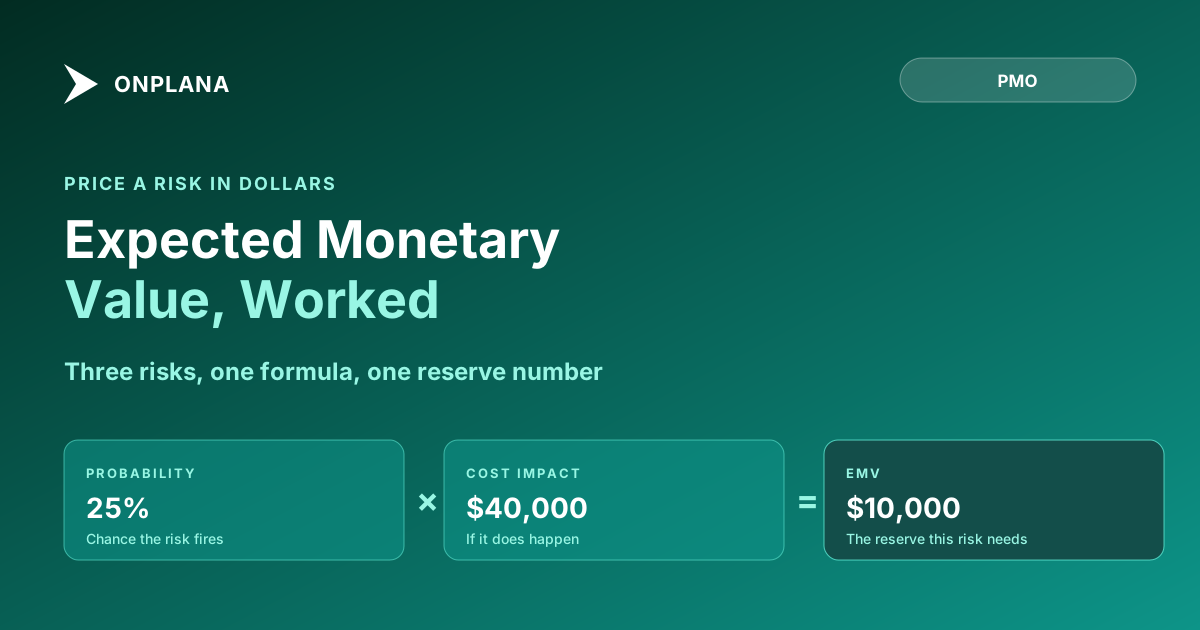
The direct answer: EMV multiplies a risk's probability of occurring by its cost impact if it does. A risk with a 20% chance of adding $50,000 to the budget has an EMV of $10,000. Sum the EMV of every risk a reserve is meant to cover, and the total is a defensible contingency figure traceable to specific, named risks rather than a round-number guess.
A risk register full of "High/Medium/Low" labels tells you what to worry about, not how much to set aside. Expected monetary value converts probability and cost impact into a dollar figure per risk, and those figures sum, which a 1-5 risk score never can. It's the calculation that turns "we think this is risky" into a number finance can actually approve.
The Expected Monetary Value Formula, and Why It Works
EMV is one multiplication: probability × cost impact = EMV. For a threat (a risk that costs money if it fires), the result is negative; write it as the size of the reserve needed to cover it. For an opportunity (a risk that saves money), the result is positive.
The reason this beats a qualitative score is units. A risk matrix might score a risk "12" (a 4 likelihood times a 3 impact on a 1-5 scale), and a second risk "9." You know 12 is worse than 9, but you can't add 12 and 9 into a budget line, because neither number is a dollar amount or a probability. EMV uses real probabilities and real dollar impacts, so the outputs are additive: $10,000 plus $4,500 is a meaningful $14,500, and that total is what the contingency reserve for those two risks should be.
A Worked Example: Three Risks, One Register
Take three risks from a mid-size software delivery project, each with a probability and a cost impact the team actually believes.
| Risk | Probability | Cost Impact | EMV |
|---|---|---|---|
| Vendor API delivery slips past the integration window | 25% | $40,000 | $10,000 |
| Key backend engineer takes planned leave mid-project | 40% | $15,000 | $6,000 |
| Load testing reveals a scaling rewrite is needed | 10% | $90,000 | $9,000 |
| Total EMV (contingency reserve) | $25,000 |
Each row is a separate multiplication. The total, $25,000, is the contingency reserve size that traces back to three named risks, each with its own probability and cost impact on record. When a finance reviewer asks "how did you get that number," the answer is the table, not "we added 10 percent to be safe."
The diagram below shows the calculation for the first risk as a decision tree: one branch where the vendor delay happens, one where it doesn't, and the weighted outcome that produces its EMV.
Aggregating EMV Across a Risk Register
A single risk's EMV is useful on its own, but the real payoff is summing across the register: the total EMV for every risk a reserve is meant to cover is the reserve's defensible size. This is exactly how contingency reserve should be sized, as opposed to management reserve, which covers unknown-unknowns the register can't see and is sized as a policy percentage instead.
Summing works because EMV outputs share units (dollars), unlike a 1-5 risk score. That additive property is the entire reason to do the calculation instead of stopping at a probability-times-impact matrix: a matrix ranks risks against each other, but it can't tell you what to put in a budget line.
Two Ways EMV Gets Misused
EMV is a simple calculation, which makes the two common misuses easy to walk into without noticing.
Treating a one-off catastrophic risk as an average. A risk with a 2% chance of a $2 million loss has an EMV of $40,000. Budgeting exactly $40,000 for it is a mistake: EMV describes the average outcome across many repetitions of a risk, but a catastrophic risk fires once, in full, or not at all. It never partially happens for $40,000. A risk in this shape, low probability, severe impact, needs a response plan (avoid, transfer, or a dedicated contingency far larger than its EMV), not a reserve line sized to the average.
Double-counting a risk already inside the estimate. If a task's cost or duration estimate already assumes some slippage, a three-point PERT estimate that widens the range for uncertainty, adding a second EMV-based reserve for that same risk pays for it twice. Before sizing a reserve from the register, check what the underlying estimates already absorbed. The PMO's risk management guide covers how to keep the estimate and the reserve from quietly overlapping.
Both mistakes share a root cause: treating EMV as a number that replaces judgment rather than one that requires it. The calculation tells you the average; deciding whether a risk's shape makes the average the right number to act on is still the PM's job.
Where EMV Sits Next to Risk Appetite
EMV answers "how much should we set aside." It doesn't answer "how much risk are we willing to carry in the first place," which is a policy question set above the register, by risk appetite and risk tolerance, not calculated from it. A register full of accurate EMV figures still needs a stated appetite to decide which risks get a reserve, which get an active response plan, and which get accepted outright.
What happens next for most teams running this for the first time: pull the top five risks off the current register, add a probability and a cost impact to each if they're missing, multiply, and sum. The total is a number to bring to the next budget review, and it's a stronger opening line than "we added a buffer to be safe." The rest of the Onplana blog covers the wider risk and budget practice these reserves sit inside.
Frequently asked questions
What is expected monetary value in project management?
Expected monetary value (EMV) is a risk's probability of occurring multiplied by its cost impact if it does. A 20% chance of a $50,000 overrun has an EMV of $10,000, the amount a reserve needs to cover that single risk on average.
How do you calculate expected monetary value?
Multiply the risk's probability (as a decimal) by its cost impact. For a threat, the result is negative; for an opportunity, positive. To size a reserve across a register, sum the EMV of every risk the reserve is meant to cover.
Is expected monetary value the same as a risk score?
No. A risk score from a probability-times-impact matrix is a rank (a 12 versus an 8) with no units. EMV is a dollar figure you can add, subtract, and hand to finance, because probability and impact are real numbers rather than a 1-5 scale.
What's the biggest mistake teams make with EMV?
Averaging a catastrophic, low-probability risk the same way as a routine one. A 2% chance of a $2 million loss has an EMV of $40,000, but budgeting only $40,000 for it is wrong: that risk needs a response plan, not a reserve line, because the one time it fires, an average doesn't pay the bill.
Can EMV double-count a risk already in the estimate?
Yes, and it's a common error. If a task's duration or cost estimate already assumes some slippage (a three-point PERT estimate, for instance), adding a separate EMV-based reserve for that same risk pays for it twice. Check what's already baked into the estimate before sizing the reserve.
Do you need software to calculate expected monetary value?
No. EMV is one multiplication per risk and one sum across the register; a spreadsheet handles it. Monte Carlo simulation is the more rigorous next step for a full cost or schedule model, but a register-level EMV calculation needs nothing more than the probabilities and cost impacts you should already have.
Ready to make the switch?
Start your free Onplana account and import your existing projects in minutes.