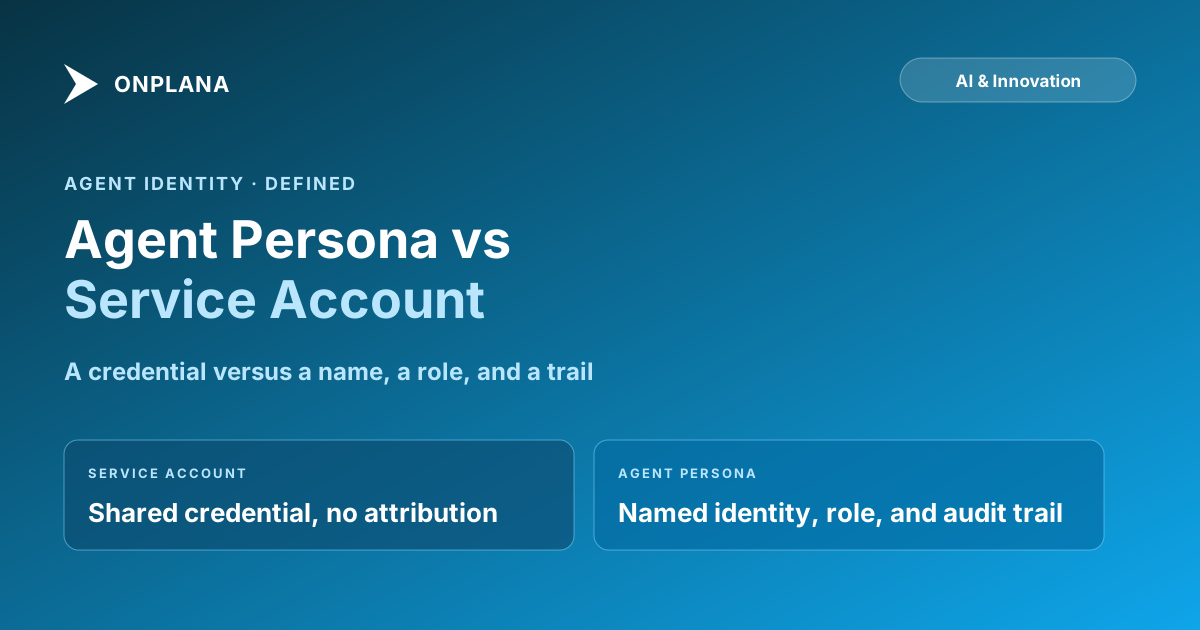
AI Agent Identity vs Service Account: The Difference
AI agent identity vs service account: a service account is a shared credential; a persona is a named identity with a role and an audit trail behind it.
Most teams give a new AI agent a login the same way they'd give a script one: generate a credential, grant it access, move on. That works fine right up until two agents share the same service account and something goes wrong, because the log that's supposed to explain what happened shows a credential, not an actor.
The direct answer: AI agent identity vs service account comes down to one distinction. A service account is a shared, non-human credential an application authenticates with; it has no individual attribution built in. An agent persona is a named, persistent identity assigned to one specific agent, carrying a role, a permission scope, and an audit trail tied to that name and no other. The difference decides whether "who did this" has an answer six months later, or just a credential that three different automations happened to share.
A service account authenticates an application; it doesn't identify which one of several automations behind it actually acted. An agent persona is a named identity assigned to one agent specifically, with its own role, its own permission scope, and its own audit trail. The gap between the two only shows up when something needs to be traced, reviewed, or reversed, which is exactly the moment a shared credential stops being good enough. Give each agent doing real work its own persona before that moment arrives, not after.
What a Service Account Actually Is
A service account is a credential an application or workload authenticates with instead of a person, the pattern every major cloud platform uses for machine-to-machine access. It's the right tool for a script that runs the same job every time: back up a database, sync a file, rotate a key. The account holds permissions, and every action taken under it is attributed to the credential, not to a distinguishable actor behind it.
That model breaks down the moment more than one thing uses the same credential, or the thing behind it starts making judgment calls instead of running a fixed routine. A backup script and an AI agent triaging support tickets can both technically authenticate with a service account, but only one of them needs anyone to ever ask "why did it do that."
AI Agent Identity vs Service Account: What a Persona Adds
A persona is a service account's structural upgrade for anything that acts on judgment instead of a fixed script: the same underlying need for machine authentication, plus the three things a shared credential can't hold.
| Service account | Agent persona | |
|---|---|---|
| Identity | Shared credential, one per system integration | Named, persistent, one per agent |
| Attribution | "The credential did it" | "This specific agent did it" |
| Role | Undefined, implied by whatever it's granted | Explicit, bounds expected work |
| Permission scope | Often broad, set once at provisioning | Scoped to the task, reviewable and revocable |
| Audit trail | Logged to the credential | Logged to the persona specifically |
| Failure mode | Can't tell which of several users caused an incident | Traceable to one actor by design |
Name. A persistent name is what turns a log line from "service account acted" into "the triage agent acted," which is the difference between a credential and an actor a reviewer can actually question.
Role. An assigned role bounds what kind of work the persona is expected to do, so an action outside that remit is visibly anomalous instead of indistinguishable from everything else the credential does.
Audit trail. Every action a persona takes should be queryable against that persona specifically, not reconstructed by cross-referencing timestamps against a shared credential's combined log. Audit trail requirements for agent work covers what that log needs to hold up under review.
The diagram below shows the structural difference: one shared credential with no internal attribution, against three distinct personas each carrying their own identity, role, and trail.
Why This Distinction Matters Six Months Later
The gap between a service account and a persona is invisible on day one. Everything works, permissions are granted, tasks get done. It becomes visible the first time something needs review: a client complains about a message they didn't expect, a task gets closed that shouldn't have been, a field changes and nobody can say why. With a shared service account, the honest answer is "one of the automations using this credential did it, we can't isolate which." With a persona, the answer is a name, a role, and a queryable trail of exactly what that persona read and did before acting.
AI agents are team members, not tools makes the same argument from the management side: a team member gets a name and a history; a feature toggle doesn't. A persona is the identity layer that framing actually requires underneath it. Without one, "treating the agent like a team member" is a metaphor with nothing structural behind it.
What an Agent Identity Should Carry
An identity record built for an agent, not retrofitted from a service account, needs four things:
- A name that persists across sessions and deployments, so the same agent is recognizable in a log a year from now, not just at the moment it was configured.
- An assigned role that states what kind of work the persona is expected to do, so anything outside that remit is visibly anomalous.
- A permission scope granted to that identity specifically, reviewable and revocable independent of any other agent sharing the same underlying system.
- An audit trail attributable to the persona, held in the same log as human activity rather than a separate system log a reviewer has to go find.
Agent-native project management covers why the underlying data model has to be built around this from the start: a chat sidebar bolted onto software that wasn't designed for agent identity can't hold a persona's role, scope, or trail, no matter how convincing the display name looks. Onplana's agent framework applies this identity model directly: every connected agent gets its own persona, its own scoped access, and its own entry in the same audit log that already tracks human activity.
The rest of the Onplana blog covers the adjacent identity questions: how autonomy scales as a persona's scope widens, what the audit trail underneath it needs to hold up under review, and what changes procedurally once an agent has an identity worth managing instead of a credential worth sharing.
Frequently asked questions
What is the difference between an AI agent identity and a service account?
A service account is a shared credential an application authenticates with; it has no individual attribution. A persona is a named, persistent identity assigned to one agent, with a role, a scoped permission set, and an audit trail tied to that name specifically.
Can a service account do everything a persona can?
Technically, yes, a service account can hold the same permissions. What it can't hold is attribution: when three different automations share one service account, a log entry shows the credential, not which automation actually acted, and that gap is the whole problem.
Why does attribution matter more for an agent than for a script?
A script does the same thing every time, so knowing which script ran rarely matters. An agent makes judgment calls that vary by input, so knowing which specific agent, with which specific instructions, produced a given action is what makes the action reviewable at all.
Can someone impersonate an agent's persona through a shared credential?
Yes, if the persona is just a display name layered over a shared service account. A real persona ties its identity to its own credential and its own permission grant, so an action attributed to it cannot have actually come from someone else's automation.
What happens to the audit trail if an agent with a persona is decommissioned?
It should persist, the same way a departed employee's activity history persists after their account is disabled. Deleting the persona's access should be immediate; deleting its history would erase the only record of what it did while it had that access.
Is renaming a service account the same as giving an agent a persona?
No. A display name change doesn't add a permission scope, an audit trail, or attributable ownership; it just makes a shared credential easier to read in a list. A persona is a structural identity, not a label on top of an unstructured one.
Does every AI agent need its own persona, even for small, low-risk tasks?
Low-risk tasks can tolerate a shared account temporarily, but the moment two agents share one identity, you lose the ability to say which one did what if either goes wrong. The cost of a persona is small enough that defaulting to one avoids finding this out during an incident.
What should an agent's identity record actually store?
A name that persists across sessions, an assigned role that bounds its expected work, a permission scope reviewable independent of the role, and a complete log of its actions queryable in the same system that logs human activity.
Ready to make the switch?
Start your free Onplana account and import your existing projects in minutes.