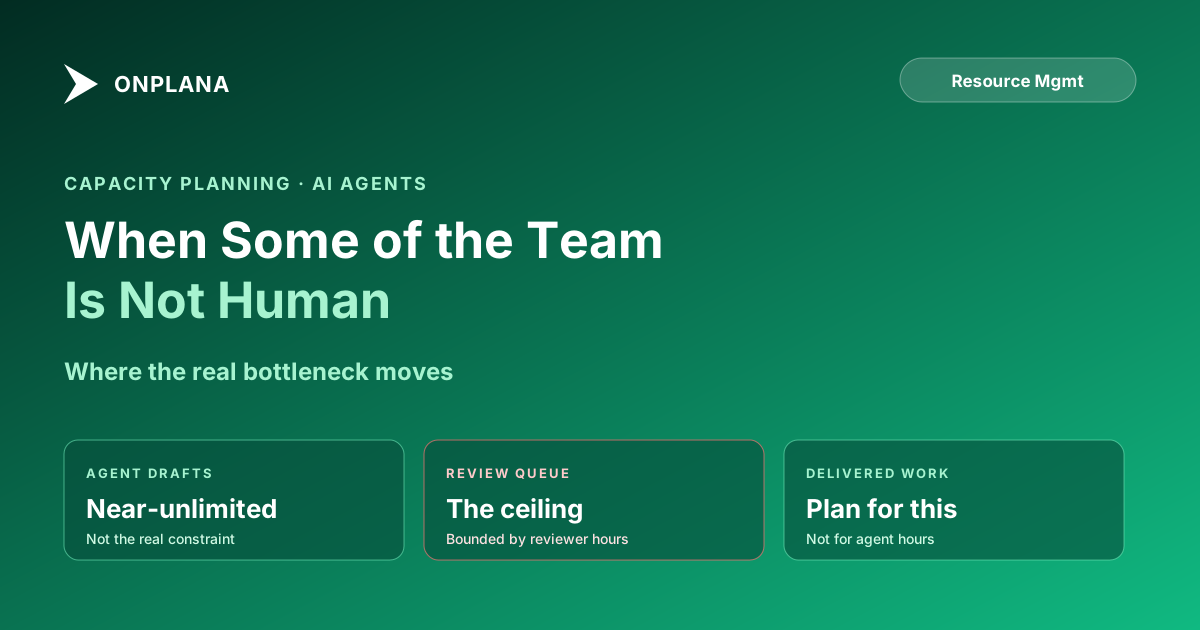
Capacity Planning When Some of the Team Is Not Human
Capacity planning with AI agents fails on hours-based math. Agents don't tire, but every output still needs review, and review time is the real ceiling.
The instinct when a team adds an AI agent is to treat it as a capacity increase and plan accordingly: one more worker, more hours available, more throughput. That instinct is wrong in a specific and predictable way, and teams that don't catch it end up with a review queue nobody planned for instead of the output they expected.
The direct answer: capacity planning with AI agents breaks the arithmetic that human capacity planning relies on, because an agent has no fixed hours and doesn't fatigue, but everything it produces still needs a human to check it before it counts as done. The binding constraint moves from delivery capacity (how much work can get drafted) to review capacity (how much of that drafted work a human can actually verify), and a plan that only tracks the first number will look healthy right up until the review queue backs up.
TL;DR: Plan against review capacity, not agent hours
- Agent hours aren't a scarce resource. An agent can draft continuously; that number tells you almost nothing about delivered output.
- Review hours are the real ceiling. Every agent output needs a qualified human check before it's done work.
- The failure mode is a backlog, not a shortage. Unreviewed drafts pile up quietly instead of showing up as an obvious capacity gap.
- Plan the review budget explicitly, per person, per week, the same way you'd plan billable hours.
Why Capacity Planning With AI Agents Breaks the Old Math
Human capacity planning multiplies people by available hours, subtracts time off and overhead, and compares the result against demand. It works because the two sides of that equation, people and hours, are both scarce and both roughly fixed. An agent breaks that assumption on one side only: it can run continuously, take on parallel tasks, and never needs a day off, so the "hours available" side of the equation stops being a meaningful constraint the moment an agent joins the roster.
That looks like good news, and for drafting throughput it is. But a project isn't done when a draft exists; it's done when the draft has been checked and approved, the same standard that applies to a human's work. Should AI agents mark work complete themselves covers why that checkpoint should stay in place regardless of how reliable an agent has been: the review step is what converts a draft into delivered work, and nothing about adding an agent removes that step. It just moves who spends time on it.
The Constraint That Actually Binds: Review Capacity
Once delivery capacity stops being scarce, review capacity becomes the number that determines real throughput, and it behaves nothing like the number it replaced.
Review capacity is bounded by the same limits human delivery capacity always had: a finite number of qualified reviewers, a finite number of hours in their week, and a fixed amount of time each review actually takes. Unlike agent output, none of that scales just because you connect another agent. Two agents drafting in parallel don't create a second reviewer; they create twice the review queue for the same reviewer. Reviewing work an agent did runs into the identical asymmetry from a different angle: the mechanism that decides when an agent stops and hands off is only useful if there's reviewer time on the other end of that handoff to receive it.
The table below lines up the two models side by side, because the columns that used to move together now move independently.
| Dimension | Human-only capacity model | Agent-inclusive capacity model |
|---|---|---|
| What's scarce | People-hours | Reviewer-hours specifically, not total team hours |
| Delivery throughput | Bounded by hours worked | Effectively unbounded per agent, bounded by concurrent agent connections and task queue depth |
| Where a bottleneck shows up | Visibly, as a missed deadline or an overloaded person | Quietly, as a growing unreviewed-work queue that doesn't look like a capacity problem until it's large |
| What "more capacity" means | Hire, or extend hours | Add reviewers or narrow what needs review, not add more agents |
| Planning unit | FTE-weeks against a demand pipeline | Reviewer-hours against a draft-output pipeline |
The diagram below shows the same shift: in the old model, the bottleneck sits at delivery; in the agent-inclusive model, delivery stops being the constraint and the bottleneck moves downstream to review.
How to Plan Against the Constraint That Actually Binds
Treat review capacity as the planning unit, not agent throughput, and the process looks closer to familiar resource capacity forecasting than to anything agent-specific.
- Estimate review time per task type, not per agent. A drafted status report might take five minutes to check; a drafted budget reallocation might take forty. Group agent-touched work by review effort, not by which agent produced it.
- Set a weekly review budget per qualified reviewer. Treat it the same way you'd treat billable capacity: a fixed number of hours available for checking agent output, separate from that person's own delivery work.
- Track queue depth, not just completion rate. A rising count of drafted-but-unreviewed items is the leading indicator of an overloaded reviewer, and it shows up well before a deadline slips.
- Widen review capacity before widening agent access. Adding a second agent connection without adding review bandwidth just doubles the backlog. How much an agent is allowed to touch and how much review capacity exists to check it should expand together, not one ahead of the other.
- Revisit the estimate as trust builds. When it's appropriate to let an agent close its own work without a full review shrinks the review-time estimate for that task type specifically, which is the only legitimate way agent-inclusive capacity actually grows over time.
The team that gets this right doesn't measure success by how much an agent produced. It measures success by how much of that output cleared review without becoming a bottleneck, which is the number that was always going to determine real throughput, agent or not. More on how AI agents change the rest of the planning picture, estimation, status reporting, permissions, is on the Onplana blog.
Frequently asked questions
How does capacity planning work with AI agents on the team?
The usual hours-times-people math stops applying, because agents don't have fixed hours or fatigue. Plan against review capacity instead: how much agent output a human can check in a given week, since that is the ceiling that actually limits throughput.
How much work can an AI agent absorb?
More than the arithmetic suggests and less than the review queue can clear. An agent can draft, research, or update work continuously, but none of it counts as delivered capacity until a person has checked it, so the honest answer is bounded by reviewer hours, not agent hours.
What is the binding constraint in a team that includes AI agents?
Review capacity. Delivery capacity effectively stops being scarce once an agent can produce drafts around the clock; what stays scarce is the number of hours a qualified human has to check that output before it counts as done.
Does adding an AI agent increase team capacity?
It increases drafting throughput, not delivered throughput, until review capacity also grows. A team that adds an agent without planning for the added review load usually ends up with a growing backlog of unreviewed work instead of more finished output.
Ready to make the switch?
Start your free Onplana account and import your existing projects in minutes.