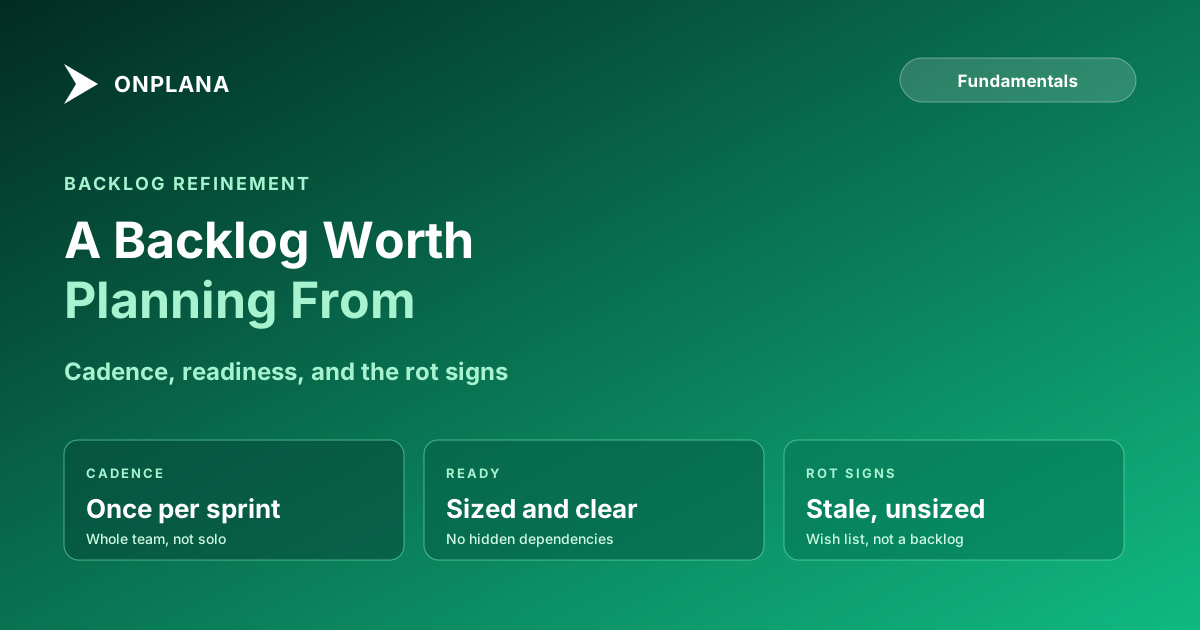
Backlog Refinement: Keeping a Backlog Worth Planning From
Backlog refinement is the ongoing work that keeps sprint planning from becoming a scramble. Here's the cadence, the definition of ready, and the rot signs.
Here's the pattern that shows up in almost every sprint planning session that runs long. The product owner pulls up a story, reads the title out loud, and the room goes quiet. Nobody remembers writing it. The acceptance criteria are one vague sentence. Someone asks whether it depends on a service that shipped last quarter or one that's still being built, and nobody knows. Forty minutes of planning time disappears clarifying a single story that a proper backlog refinement session should have sorted out a week earlier.
That failure isn't a sprint planning problem. Sprint planning just surfaces it. The actual problem is upstream: nobody kept the backlog refined, so planning inherited work that was never made ready to plan. Backlog refinement is the unglamorous, easy-to-skip discipline that keeps that scramble from happening, and teams that treat it as optional busywork pay for the skip in every planning meeting that follows.
TL;DR. Backlog refinement is the ongoing activity of clarifying, sizing, and ordering Product Backlog items before they're needed in sprint planning, not a one-time cleanup. Run a dedicated session roughly once per sprint with the whole delivery team present, not just the product owner. Only the next one to two sprints' worth of work needs full detail; items further out need just enough clarity to confirm they're still worth doing. A backlog with stale, unsized items piling up at the top, or planning sessions that keep hitting unready stories, are the two clearest signs refinement has fallen behind.
What Backlog Refinement Actually Is
Backlog refinement, sometimes called backlog grooming, is the ongoing work of taking raw backlog items and turning them into something sprint planning can actually pull from: a clear description, testable acceptance criteria, an estimate the team agrees on, and a rough priority order. It isn't a single meeting that happens once and finishes the backlog forever. It's continuous maintenance, the same way keeping a codebase free of dead code is continuous maintenance rather than a one-time cleanup sprint. The payoff of that maintenance is a backlog that feeds the plan: items that are ready to pull, instead of a list nobody trusts.
The Scrum Guide describes refinement as an ongoing activity, defining it as breaking down and further defining Product Backlog items into smaller, more precise items, adding details such as a description, order, and size as an ongoing part of the team's work rather than a separate phase. That framing matters because teams that treat refinement as optional, something to squeeze in "if there's time," end up doing all of that clarifying work live during sprint planning instead, which is the most expensive possible place to do it: the whole team is in the room, on the clock, discovering ambiguity that could have been resolved by two people a week earlier.
Why Does an Unrefined Backlog Wreck Sprint Planning?
Sprint planning is supposed to be a selection exercise: pick already-ready stories in priority order until the sprint's calculated capacity is reached. When the backlog isn't refined, planning quietly turns into a discovery exercise instead, because half the candidate stories aren't actually ready to be selected. The team ends up doing refinement's job, clarifying scope, agreeing on acceptance criteria, estimating for the first time, inside a meeting that was supposed to take an hour and now takes three.
The damage compounds beyond the wasted meeting time. Stories rushed through ad-hoc clarification during planning get worse acceptance criteria than stories refined calmly a week in advance, because the room is under time pressure to move on to the next item. Those weaker acceptance criteria show up later as mid-sprint surprises: a story that seemed clear enough to commit to turns out to have a hidden assumption nobody caught, because nobody had the space to catch it. A team that consistently blows through its sprint planning timebox is very often looking at a refinement problem wearing a planning-meeting costume.
How Often Should Refinement Happen, and Who Attends?
Most teams run one dedicated refinement session per sprint, typically scheduled around the midpoint, lasting somewhere between 45 minutes and an hour for a standard two-week sprint. That cadence gives the team enough time to act on whatever gets clarified, refining stories a week before they're needed rather than the day before planning, while keeping the backlog fresh enough that refined items don't go stale before they're actually pulled into a sprint.
Attendance is where teams most often get refinement wrong. It's tempting to treat refinement as a product owner's job, something they do alone before handing a tidy backlog to the team. That produces backlogs that look refined on paper and fall apart the moment the delivery team actually looks at them, because the people doing the estimating and the people doing the building were never in the same room. Refinement works when the product owner brings the business context and the whole delivery team brings the "can we actually build this, and how big is it really" judgment, together, in the same session. A story sized by a product owner alone is a guess. A story sized by the team that will build it is an estimate.
What Counts as a Story Being "Ready"?
A shared definition of ready is what keeps refinement from being a subjective, argue-every-time exercise, and it's worth keeping tight rather than open-ended: see what separates a falsifiable definition of ready from a decorative one, and how it differs from a definition of done. Most teams converge on some version of this checklist:
- Acceptance criteria are specific and testable. "Users can filter their results" fails this test. "Users can filter results by date range, status, and assignee, with filters combining as AND conditions" passes it.
- External dependencies are identified and either resolved or explicitly scoped around. A story blocked on a vendor integration that hasn't shipped doesn't meet the bar, no matter how well-written its acceptance criteria are.
- The team has estimated it, using planning poker or a comparable technique, during refinement rather than for the first time in planning.
- It's small enough to fit comfortably inside a sprint. A story sized at more than roughly a third of the team's sprint capacity is a signal to split it during refinement, not a signal the team needs a bigger sprint later.
- Someone can explain what "done" looks like in under thirty seconds, unprompted. If that explanation produces disagreement in the room, the story isn't ready; it's an argument waiting to happen mid-sprint instead.
A story that fails any of these stays in the backlog for another round of refinement rather than getting pulled into planning on the strength of its priority alone. Urgency is a reason to refine a story sooner, not a reason to skip the checklist.
How Far Down the Backlog Should Refinement Go?
The diagram above shows the shape that most healthy backlogs converge on. The next one to two sprints' worth of work gets full detail: sized, with clear acceptance criteria, dependencies checked. The following quarter's worth of work gets a lighter pass, enough to confirm the rough shape and priority order without investing in acceptance criteria that will likely change before the item is actually built. Anything further out than that stays at idea level, just enough detail to confirm the item is still worth having on the backlog at all.
The mistake teams make in both directions is refining too deep or too shallow relative to the horizon. Fully detailing a story that's six months out wastes the effort when priorities shift and the story gets reprioritized, deprioritized, or reworked before it's ever pulled into a sprint, which happens more often than teams like to admit. Refining too shallow on next-sprint work is the opposite failure, the one that produces the planning-meeting scramble described above. The right amount of detail scales down as the horizon extends outward; treating every backlog item the same regardless of how soon it's needed is the root cause of both failure modes.
The Warning Signs Your Backlog Has Rotted Into a Wish List
A few signals reliably indicate refinement has fallen behind rather than simply being a light process that's working fine:
Hundreds of items sitting at the top of the backlog, unsized and unordered. A backlog is a prioritized list, not a bucket. If nobody could confidently point to what's next without scrolling and re-reading everything, the ordering work that refinement is supposed to maintain has stopped happening.
Stories more than a few months old that nobody remembers the context for. Every backlog accumulates some of these, but a growing pile of them means items are being added faster than they're being refined, refined-and-rejected, or refined-and-scheduled. A stale story isn't neutral; it's actively misleading anyone scanning the backlog for what matters.
Sprint planning repeatedly surfaces unready stories. If this is happening most sprints, refinement sessions aren't covering enough ground, aren't happening often enough, or aren't reaching a real definition of ready before items get marked done.
The product owner is the only person who understands most backlog items. If sizing and clarity live entirely in one person's head instead of being captured in the backlog itself, the backlog isn't actually refined; it's a to-do list with a translator required to use it.
Running a Refinement Session That Doesn't Waste Anyone's Time
- Come in with a shortlist, not the whole backlog. The product owner pre-selects the candidates most likely to be needed in the next sprint or two; refinement isn't the place to review a thousand-item backlog from the top.
- Walk each item's acceptance criteria out loud before estimating. Sizing before the team agrees on what the story actually covers produces estimates for the wrong scope.
- Estimate as a group, using the same relative-sizing technique the team uses in sprint planning, so refinement estimates and planning estimates speak the same language.
- Split anything that can't be confidently sized in a couple of minutes of discussion. Extended debate about a story's size is usually a sign the story is actually two or three stories.
- Flag dependencies and unresolved questions explicitly, with a named owner to chase down the answer before the item is considered ready again.
- Reorder the shortlist based on what came out of the session. Refinement often reveals that a lower-priority item is actually more ready, and therefore more sensible to schedule sooner, than something ranked above it.
- Stop on time. A refinement session that runs long is usually trying to refine too much in one sitting; better to refine a smaller set well than a larger set superficially.
Onplana's Backlog view groups unassigned work by epic so refinement sessions can work through a coherent theme at a time instead of an arbitrary top-of-list scroll, and inline-edit on estimated hours and priority keeps the output of the session captured in the same place planning will look for it next.
Refinement Is Maintenance, Not a Meeting to Survive
A backlog that stays genuinely refined turns sprint planning back into what it's supposed to be: a selection exercise against already-ready, already-sized work, not a discovery session wearing a planning meeting's name. The discipline required is small and unglamorous, a weekly hour of clarifying, sizing, and reordering, but it's the discipline that keeps every downstream meeting, planning, standups, the sprint itself, from inheriting problems that a slightly earlier conversation would have caught for free.
Frequently asked questions
What is backlog refinement?
Backlog refinement, also called backlog grooming, is the ongoing work of adding detail, estimates, and order to Product Backlog items so the highest-priority items are clear and sized before sprint planning needs them.
How often should a team refine its backlog?
Most teams run a dedicated refinement session once per sprint, roughly midway through, plus smaller ad-hoc refinement whenever a story needs clarifying detail. For a two-week sprint that's typically one 45 to 60 minute session.
Who should attend backlog refinement?
The product owner, the whole delivery team, and anyone who can answer open questions about upcoming work. Refinement isn't a product-owner-only activity; the people who will build the work need to be part of sizing and clarifying it.
What is the definition of ready?
A definition of ready is the checklist a backlog item must pass before it can enter sprint planning: clear, testable acceptance criteria, no unresolved external dependencies, and an estimate the team has already agreed on.
How far down the backlog should refinement go?
Refine the next one to two sprints' worth of work in detail. Items further out need only enough clarity to confirm they're still worth pursuing, not full sizing, because detailed work on items three months out is often thrown away when priorities shift.
What are the signs a backlog needs a bigger refinement push?
A backlog with hundreds of stale, unestimated items at the top, stories more than a few months old that nobody remembers the context for, and sprint planning sessions that keep discovering unready stories mid-meeting are all signs refinement has fallen behind.
Ready to make the switch?
Start your free Onplana account and import your existing projects in minutes.