Rolling Wave Planning Without Losing the Plot
Rolling wave planning details the near term and leaves the far term coarse. Here's how far ahead to plan, what triggers the next wave, and what to report.
Plan a twelve-month schedule down to the task level in month one, and most of that detail is wrong by month four. Requirements shift, a vendor's timeline moves, a dependency nobody anticipated shows up. The team spends real hours re-planning work it had already "finished" planning, and each re-plan quietly erodes trust in the schedule the next time someone asks whether a date is real.
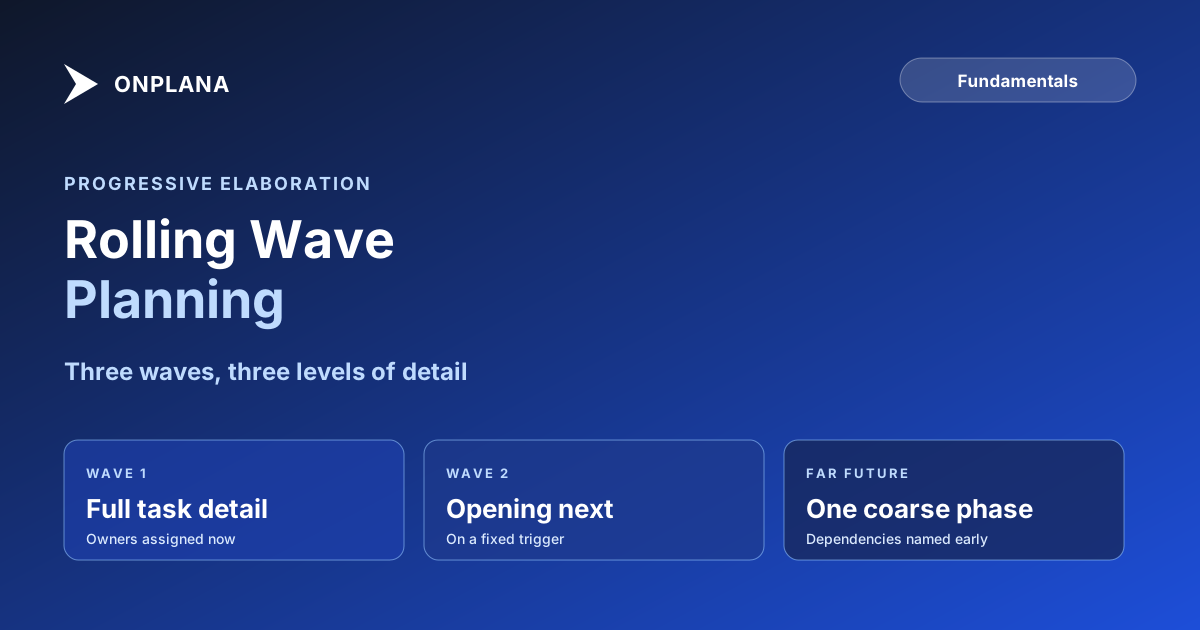
The direct answer: rolling wave planning solves this by detailing only the near-term work, typically four to eight weeks out, at full task level, while representing everything beyond that horizon as a single coarse placeholder phase with a rough duration and no task breakdown. As the current wave finishes, the next chunk of the coarse future gets detailed in turn, wave by wave, so planning effort is spent once on work that's about to happen instead of repeatedly on work that's still going to change. It's a form of progressive elaboration, the broader technique of refining a plan as better information becomes available.
Rolling wave planning details the next four to eight weeks at task level and leaves everything beyond that horizon as one coarse placeholder phase. A new wave opens on a fixed cadence, not when the current one runs dry. Every coarse future phase still has to name its known dependencies up front, even before its tasks are broken out, or a predecessor gets discovered too late to plan around. Report the detailed wave's progress at task level and the coarse waves as date commitments only, since giving both the same reporting precision is how a rolling wave plan starts misleading its own steering committee.
How Far Ahead to Detail
The near-term wave needs to be long enough to schedule real dependencies and assign real owners, and short enough that the detail is still accurate when the work actually starts. In practice that's a four-to-eight-week window for most delivery work: long enough to sequence a handful of interdependent tasks and staff them against real availability, short enough that a scope change discovered next month doesn't waste weeks of detailed planning that already happened.
A wave stretched much past ten weeks starts reproducing the problem rolling wave planning exists to solve, just on a longer cycle: detail gets written for work far enough out that it changes before it starts, and the team re-plans it anyway. A wave compressed to a single week, on the other hand, turns planning into a constant background task with no room to think past the next few days. The right window is the longest one where the detail still holds.
What Triggers the Next Wave
The next wave should open on a fixed schedule, not whenever someone gets around to it. Two cadences work well in practice: a calendar trigger (plan the next wave every two or four weeks, regardless of how the current one is going) or a runway trigger (plan the next wave once the current one has two weeks of detail left, whichever comes first). Either one keeps a wave of detail in the pipeline at all times.
The failure mode to avoid is waiting until the current wave is nearly exhausted before starting to plan the next one. That reintroduces exactly the scramble rolling wave planning was supposed to remove, just shifted from "plan everything up front" to "plan nothing until it's urgent." A fixed trigger, checked on a recurring cadence rather than judged case by case, is what keeps waves overlapping instead of leaving a gap between them.
The diagram below shows three waves in flight at once: the current wave in full detail, the next wave partially opened, and the far future still coarse.
How to Keep a Coarse Future From Hiding a Dependency
The risk in leaving a future phase undetailed is that a dependency buried inside it stays invisible until the phase gets planned, sometimes too late to arrange for it. The fix is a rule, not a hope: every coarse placeholder phase must name its known cross-phase dependencies up front, even though none of its internal tasks are broken out yet. If wave three depends on a vendor contract that has to be signed during wave one, that dependency gets logged against wave one's plan immediately, not discovered when wave three finally gets detailed.
This is the same discipline dependency mapping requires inside a fully detailed schedule, just applied one level up: a coarse phase is still a real predecessor or successor to something else, and progressive elaboration only works if the plan tracks what a phase depends on before it tracks what's inside it.
Rolling Wave Planning vs a Single Upfront Plan
| Single Upfront Plan | Rolling Wave Planning | |
|---|---|---|
| Detail level, far-term work | Full task breakdown from day one | One coarse placeholder phase |
| Re-planning effort when scope shifts | High: detailed tasks get rewritten repeatedly | Low: only the current wave was ever detailed |
| Planning effort per week of work | Front-loaded, all at once | Spread evenly, wave by wave |
| Dependency visibility on far-term work | Full, but frequently stale | Named at the phase level, detailed later |
| Best fit | Well-understood, low-change work | Work with real requirements uncertainty |
| Steering-committee reporting | Task-level status for the whole plan | Task-level for the current wave, date-only for the rest |
Reporting Progress Against an Incomplete Plan
A rolling wave plan has two different kinds of "progress" in it at the same time, and reporting them the same way is a common way the technique loses credibility with a sponsor. The current wave gets real percent-complete numbers, because its tasks are actually broken out and being worked. The coarse future waves get a date commitment and a scope statement, nothing more, because there's no task-level truth to report yet.
Presenting a coarse future phase with the same false precision as the detailed wave, a bar on the Gantt with an implied percent-complete, is how a rolling wave plan starts hiding uncertainty instead of managing it. The honest version of the project plan shows the current wave in full and marks everything past the horizon as a placeholder, visually distinct, so a reviewer can tell at a glance which numbers are real.
What happens next for a PMO adopting this: pick a detail horizon (four to eight weeks is the common starting point), set a fixed trigger for opening the next wave, and require every coarse phase to declare its known dependencies before its tasks exist. The work breakdown structure guide covers how to break a wave down once it's open, and milestone planning covers how to place checkpoints that still catch a slip inside a wave that's deliberately incomplete beyond it. The rest of the Onplana blog covers the wider scheduling and estimation practice a rolling wave plan sits inside.
Frequently asked questions
What is rolling wave planning?
Rolling wave planning is a progressive elaboration technique: the near-term work is planned in full task-level detail, and everything beyond a fixed planning horizon is represented as a single coarse placeholder until it enters the detail window itself. It replaces one fully-detailed upfront plan with a series of detailed near-term waves.
How far ahead should a rolling wave detail its tasks?
Most teams detail four to eight weeks ahead, long enough to schedule real dependencies and assign real owners, short enough that the detail doesn't go stale before the work starts. A wave longer than about ten weeks starts accumulating the same rework rolling wave planning exists to avoid.
What triggers the start of the next wave?
A fixed cadence, not a feeling. Most PMOs open the next wave at a scheduled interval, every two or four weeks, or a fixed number of weeks before the current wave's detail runs out, whichever comes first. Waiting until the current wave is nearly exhausted to plan the next one reintroduces the scramble rolling wave planning is meant to prevent.
Is rolling wave planning the same as agile sprint planning?
They're related but not identical. Sprint planning details one fixed-length iteration at a time and rarely plans more than one sprint ahead. Rolling wave planning is the broader technique of progressive elaboration and can span a longer detail window than a single sprint, with the coarse far-term view built explicitly into the plan rather than left unaddressed.
Does a coarse future summary hide dependencies?
It can, and that's the main failure mode. A placeholder summary phase has to name every dependency it's known to carry into future waves, even before the tasks inside it are detailed, or a critical predecessor gets discovered late instead of planned for.
How do you report progress against a plan that's deliberately incomplete?
Report percent complete against the current detailed wave, and report the coarse future waves as scope commitments with dates but no task-level status. Presenting an undetailed wave as though it has the same status precision as the detailed one is a common way rolling wave plans mislead a steering committee.
Ready to make the switch?
Start your free Onplana account and import your existing projects in minutes.