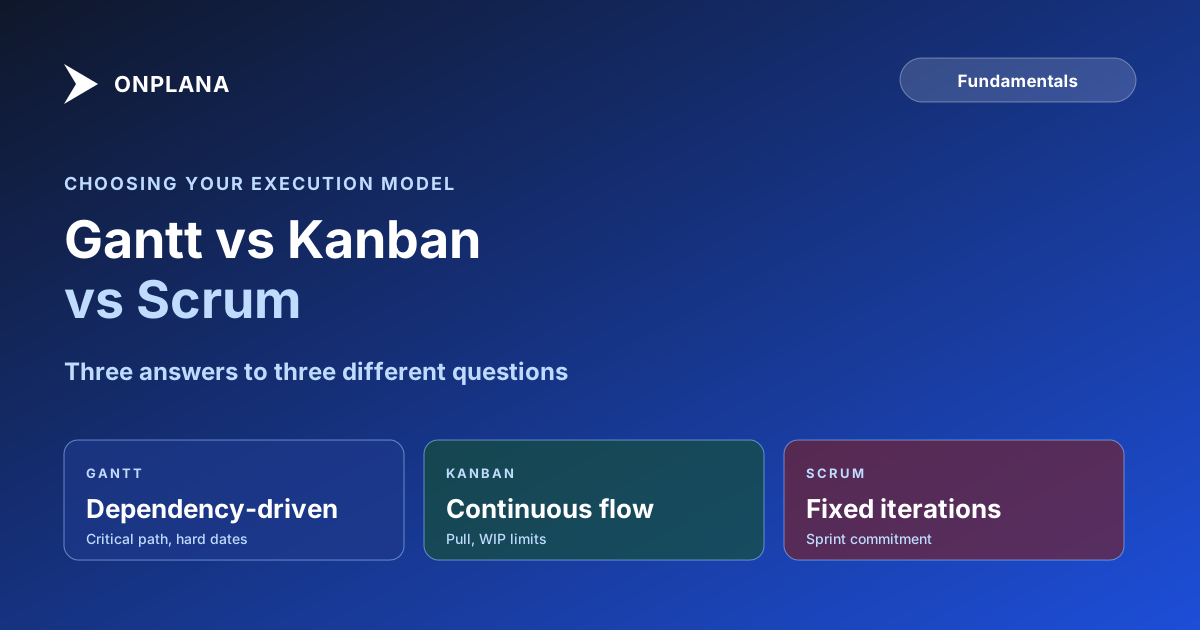
Gantt vs Kanban: Choosing the Right Execution Model
Gantt vs Kanban isn't a loyalty test. Each answers a different question about how work flows, and most real portfolios end up running Gantt, Kanban and Scrum.
Gantt vs Kanban vs Scrum gets asked like it's a single decision an organization makes once and lives with forever, the way a company picks an accounting method. It isn't. The real question is smaller and gets asked once per body of work: does this specific piece have a fixed sequence of dependencies that determines when it can finish, a continuous stream of arrivals nobody can schedule two weeks out, or a defined scope worth committing a team to for a fixed iteration. Answer that per workstream, not per company, and the tool argument mostly resolves itself.
Most organizations skip that step. They pick one board style company-wide, and then spend a year wondering why the support team's sprint burndown never means anything and why the compliance deliverable's Kanban lane keeps missing a deadline nobody saw coming. The board wasn't wrong for what it was built for. It was wrong for the work it got assigned to.
TL;DR. Gantt, Kanban, and Scrum are not competing philosophies; they're built for different shapes of work. Gantt charts schedule dependency-driven work against calendar dates and expose a critical path, the best fit when tasks genuinely depend on each other and a real deadline exists. Kanban manages continuous, unpredictable arrivals with pull and work-in-progress limits, the best fit for support queues and operational work. Scrum organizes product development into fixed-length sprints with a committed backlog, the best fit for a stable team building toward a defined release. Most real portfolios run all three at once, on different workstreams, rolling up to one plan.
Gantt, Kanban, and Scrum Solve Different Scheduling Problems
Each of the three answers a question the other two don't ask. A Gantt chart answers "when will this finish, and what's the longest chain of dependent work driving that date." Kanban answers "what's stuck right now, and how much work should be in progress at each stage before quality and speed both suffer." Scrum answers "what is this team committing to build in the next two to four weeks, and how do we know if that commitment is at risk."
None of those questions is more sophisticated than the others; they're just different questions. A regulated deliverable with twelve dependent workstreams needs the first question answered constantly. A support queue with unpredictable ticket volume needs the second. A product team shipping a defined release needs the third. Forcing one methodology to answer all three questions at once is why teams end up maintaining a Gantt that nobody trusts, a Kanban board with no WIP limit, or a sprint that gets replanned every three days.
What Is a Gantt Chart Actually Optimizing For?
A Gantt chart plots tasks against a calendar with dependencies drawn between them, and its entire value proposition is the critical path: the longest chain of dependent tasks, which sets the minimum possible finish date for the whole plan. Everything else on the chart, the bars, the percent-complete shading, the resource assignments, exists to support that one calculation.
Gantt-driven scheduling wins when dependencies are real and consequential. If Task D genuinely cannot start until Task B finishes, and a slip in B pushes the whole project's end date, that dependency needs to be visible and tracked, not buried in someone's memory of what blocks what. This is why construction, regulated-industry deliverables, hardware launches, and any multi-team initiative with hard cross-team handoffs still run on Gantt logic even inside organizations that are otherwise fully agile. Onplana's Gantt with critical path highlights that longest chain automatically and flags when a delay on a non-critical task is about to eat its float and become critical itself, the kind of early warning a sprint burndown was never built to provide.
Gantt scheduling loses its advantage fast when the dependencies are fake. A schedule where every task is marked "depends on the previous task" purely to create a tidy waterfall, with no real logical constraint behind it, produces a critical path that's meaningless and a plan that resists the kind of reprioritization continuous or iterative work actually needs.
When Does Kanban's Continuous Flow Beat a Schedule?
Kanban drops the calendar entirely and manages work as a continuous system: visualize every stage, cap how much can be in progress at each stage, and pull new work only when capacity opens up rather than pushing it onto whoever's available. There's no sprint boundary and no baseline to compare against; the operative metrics are cycle time (how long an item takes once work starts) and throughput (how many items finish per period).
This fits work that arrives unpredictably and can't be batched into a two-week commitment without the plan going stale before the sprint even starts: support tickets, production incidents, ad hoc stakeholder requests, ongoing maintenance. A support team that tries to run Scrum on ticket volume ends up either padding every sprint with guesswork or replanning constantly, both of which defeat the point of a sprint commitment. The same team running Kanban gets a WIP limit that keeps the queue from silently growing past what anyone can actually finish, and a cycle-time trend that catches a slowdown weeks before it would show up as an angry customer.
Kanban's weakness is the mirror image of Gantt's strength: it has no native concept of a hard external deadline or a cross-team dependency chain. A Kanban board will happily tell you an item's average cycle time is four days without ever telling you that this particular item is blocking three other teams and needs to jump the queue.
When Does Scrum's Sprint Structure Win?
Scrum commits a stable team to a defined scope for a fixed iteration, typically one to four weeks, then reviews and replans at the boundary. The backlog gets groomed ahead of time, the team estimates and commits during sprint planning, and the burndown shows whether the commitment is on track to be met.
That structure fits product development with a stable team and a roadmap that benefits from a predictable delivery rhythm: stakeholders know when to expect the next demo, the team knows what "done" looks like for the next two weeks, and velocity, tracked consistently, gives a defensible basis for forecasting the next quarter's roadmap. It fits less well the moment the work has hard external dependencies that don't respect a sprint boundary. A team can commit to shipping a feature in this sprint and still miss the date because a partner API integration it depends on slipped, a dependency a sprint board has no native way to represent the way a Gantt's critical path does.
Gantt vs Kanban vs Scrum: The Decision Framework
The diagram below is the fastest way to run the diagnosis: start from the shape of the work, not from a preference for one methodology.
The table below maps the three models against the dimensions that actually predict fit, not the ones that show up in a marketing comparison.
| Dimension | Gantt | Kanban | Scrum |
|---|---|---|---|
| Work shape | Dependency-driven, sequenced | Continuous, unpredictable arrival | Batched, plannable in advance |
| Primary question answered | When will this finish | What's stuck right now | What are we building this iteration |
| Planning horizon | Whole project, fixed dates | Rolling, no fixed horizon | Fixed sprint length |
| Core metric | Critical path, float | Cycle time, throughput | Velocity, burndown |
| Change tolerance mid-cycle | Low; a dependency slip cascades | High; reprioritize anytime | Low mid-sprint; changes wait for the boundary |
| Best team structure | Cross-team, hard handoffs | Shared queue, single team | Stable, dedicated team |
| Reporting to executives | Milestone dates, risk to deadline | SLA and queue health | Release burndown, scope delivered |
No row in that table has a universally correct answer; each one is a match between the shape of a specific body of work and the model built for that shape. A project can score "Gantt" on three rows and "Scrum" on the rest, which is normal, not a sign the framework is failing.
A concrete example makes the mismatch easier to spot. A mid-market SaaS company launching a new compliance certification has three workstreams under one initiative: the audit-prep documentation (fixed sequence, hard external deadline set by the auditor, real cross-team dependencies between legal, security, and engineering), the engineering hardening work needed to pass the audit (plannable in two-week increments, a stable team, a groomable backlog), and the customer-support load generated once the certification ships and inbound questions spike (continuous, unpredictable, no fixed scope). Running all three on a single Scrum board makes the audit deadline invisible until it's nearly missed. Running all three on a single Gantt buries the support team's steady-state work under artificial task boxes with fake dependencies. The initiative needs a Gantt for the audit-prep dependencies, Scrum for the hardening sprints, and Kanban for the support load, reporting into one plan rather than three disconnected trackers.
Why Real Portfolios Run All Three at Once
Most PMOs managing more than a handful of active initiatives eventually run all three models simultaneously, on different slices of the same portfolio, because the alternative is forcing every workstream into a model that fits only some of them. A typical split: a Gantt with dependencies for the portfolio-level milestones and cross-team handoffs a steering committee cares about, Scrum sprints for the feature-development teams building toward those milestones, and a Kanban lane for the support and operational work that never fits a sprint boundary in the first place.
This only works cleanly when all three views share the same underlying task data rather than living in separate tools that need manual reconciliation every Friday afternoon. Onplana's Gantt, Sprint board, and Kanban board read and write the same task records, so a task can belong to a sprint, carry a finish-to-start dependency, and appear on the Gantt with the critical path highlighted, all without an export or a spreadsheet in between. The waterfall vs agile debate usually assumes an organization has to pick a side; in practice, the portfolios that work best pick per workstream and let the plan hold all three views at once.
How to Pick Without a Six-Week Committee
- Name the work's dependency structure first. If finishing this piece genuinely requires another piece to finish first, and that chain has real consequences for a deadline, start with Gantt logic regardless of what the rest of the organization runs.
- Check whether the work arrives in a batch or a stream. Work you can see and plan two weeks out fits Scrum. Work that shows up unpredictably, a ticket, an incident, an ad hoc request, fits Kanban.
- Ask whether a fixed iteration boundary helps or hurts. A stable team building toward a defined release benefits from the predictability of a sprint. A team whose priorities genuinely shift week to week loses more from a sprint's rigidity than it gains from the structure.
- Match the metric to the decision it needs to support. If the decision is "will we hit the date," track critical path and float. If it's "is the queue healthy," track cycle time. If it's "did we deliver the sprint commitment," track velocity and burndown.
- Revisit per workstream, not per company. A workstream that changes shape, a one-off project that becomes ongoing maintenance, for example, should change execution models with it, even if the rest of the portfolio doesn't move.
The debate usually gets framed as picking a winner. The more useful framing is a diagnosis: name the shape of the work in front of you, and the model that fits falls out of that answer rather than out of whichever methodology happened to win the last conference talk everyone attended.
Frequently asked questions
What is the actual difference between Gantt, Kanban, and Scrum?
A Gantt chart schedules dependency-driven work against calendar dates and shows a critical path. Kanban manages continuous, unpredictable work as a pull-based flow with work-in-progress limits. Scrum organizes product development into fixed-length sprints with a committed backlog. They answer different questions: when will this finish, what's stuck right now, and what are we building this iteration.
Can you use Gantt, Kanban, and Scrum on the same project?
Yes, and most mid-size and larger portfolios do exactly that. A common pattern is a Gantt for portfolio-level milestones and dependencies, Scrum sprints for planned feature development, and a Kanban lane for support or operational work, all reporting into the same plan.
When should a team choose Kanban over Scrum?
When work arrives continuously and unpredictably, support tickets, ops requests, ad hoc stakeholder asks, rather than in a batch that can be planned two weeks out. Kanban's pull model and WIP limits fit that arrival pattern better than a fixed sprint commitment does.
Does a Gantt chart still matter for an agile team?
Yes, at the portfolio level. Sprint boards answer what a single team is doing this iteration; a Gantt with dependencies and a critical path answers when a multi-team initiative with real cross-team dependencies will actually finish. Agile teams that skip the Gantt often discover a hard dependency the hard way, in a status meeting instead of a schedule.
What's the most common mistake in choosing an execution model?
Picking one model for the whole organization instead of matching the model to the shape of each body of work. A support queue forced into two-week sprints backs up; a hard-deadline regulatory deliverable managed as a Kanban lane loses its critical path visibility. The mistake is treating this as a single company-wide decision rather than a per-workstream one.
Is Scrum always the right choice for software projects?
No. Scrum fits product development with a stable team and a backlog that can be groomed and committed to a sprint. It fits less well for software work with hard external dependencies and fixed dates, like a compliance deadline or a partner integration cutover, where a Gantt's critical path tracking gives an earlier warning than a burndown chart does.
Ready to make the switch?
Start your free Onplana account and import your existing projects in minutes.