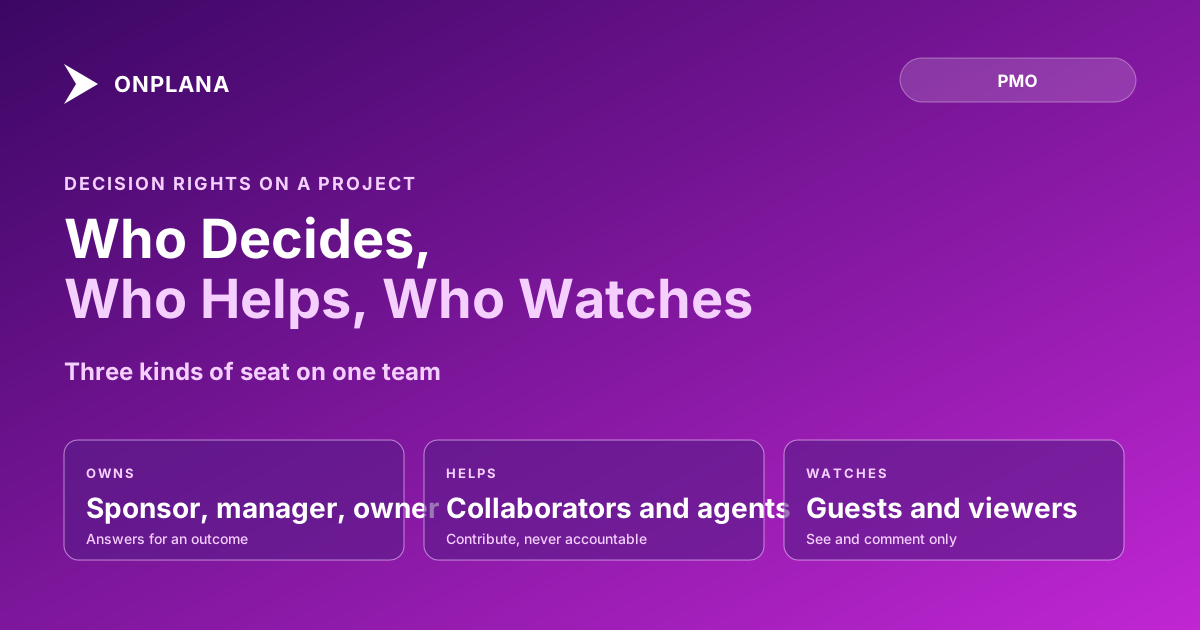
Project Team Roles: Who Owns, Who Helps, Who Just Watches
Project team roles are best defined by what each person can decide, not by job title. Seven roles, from sponsor to AI agent, mapped to real permissions.
Gallup reported in October 2015 that only about half of employees strongly agree they know what is expected of them at work (Gallup, "Many Employees Don't Know What's Expected of Them at Work"). On a project team, that gap is a role nobody defined: three people assume they approve the budget, and nobody assumes they chase the late task.
In short. Project team roles are the decision rights people hold on a project: the sponsor funds it, the project manager plans it, task owners finish work, collaborators help, reviewers approve, guests watch, and an AI agent does assigned work under a person's review. Define each role by what it can decide, then set permissions to match.
What are the main project team roles?
The main project team roles are sponsor, project manager, task owner, collaborator, reviewer, guest and AI agent. A job title tells you where someone sits on the org chart; a role tells you what they can change on this project. The same person can be a task owner on one project and a reviewer on another.
| Role | Decides | Does not decide |
|---|---|---|
| Sponsor | Whether the project is funded and continues | Day-to-day task order |
| Project manager | Scope, schedule, who is on the project | Whether the business case still holds |
| Task owner | How one task gets finished, and when it is done | Other people's tasks |
| Collaborator | Nothing alone; helps the owner | The outcome of the task |
| Reviewer | Whether a deliverable is accepted | How it was built |
| Guest | Nothing; sees and comments on one project | Anything outside that project |
| AI agent | Nothing; drafts work it is given | What gets sent or published |
The diagram below puts the same seven roles on a scale from deciding to watching.
Who owns, who helps and who just watches?
Owners answer for an outcome, helpers contribute effort, and watchers see the work without changing it. The split matters because accountability does not survive being shared. Many people can be responsible for the doing, and exactly one is accountable; the RACI, RASCI and DACI comparison draws that matrix in full, so this post stays on the roles themselves.
Two boundaries cause most of the damage. The first is the sponsor and the project manager, covered in project sponsor vs project manager: the sponsor owns the business case, the manager owns the plan. The second is the task owner and the collaborator. A task has one owner, and everyone else who touches it is a collaborator, as task assignment rules explains.
How do project roles map to permissions in a tool?
A role is only real when the tool enforces it. Onplana resolves access on two axes, per its roles and permissions documentation: an organization role, and a project role inside each project.
| Axis | Roles | What it controls |
|---|---|---|
| Organization | Owner, Admin, Portfolio Manager, Member, Guest | What you can see and create across the workspace |
| Project | Project Owner, Project Manager, Project Member, Project Contributor, Project Viewer | What you can change inside one project |
Read the two together. An organization Owner or Admin acts as Project Owner on every project, and a Portfolio Manager acts as Project Manager, with Onplana applying the higher of the two roles. Members and Guests have no minimum, so their access is exactly their project role. A sensible mapping: the sponsor is a Project Viewer who can see the work and edit nothing, the project manager holds Project Manager, a task owner is a Project Member or Contributor, and a reviewer who must comment is a Contributor, since a Viewer can only view.
Where do guests and AI agents fit?
Guests and agents are the two roles that most older role lists leave out. A guest is an external collaborator who sees only the projects they are explicitly added to, which suits a client who reviews and comments. Guest seats are free up to a plan allowance on paid plans; guest seats explained has the numbers, and one project for a contractor, a client and an in-house team shows how to mix all three.
An AI agent is assigned work the way a member is, but it carries no accountability. "Delegate to an agent" on a task posts an @mention, the agent reacts on its next sync, and anything it produces lands in the Agent review inbox. Nothing is sent or published until a person approves it, so the reviewer role belongs to a human. See AI agents are team members, not tools for the full argument.
How do you write a role list your team will use?
Write each role as one sentence beginning "can decide", then test it against a real argument from the last project.
- List the five decisions that stalled your last project, such as scope change, release date, and budget overrun.
- Name the role that holds each decision. If two roles hold one, pick one.
- Check that every role in the list is a person, not a department.
- Set the tool's permissions to match: edit rights for owners, comment rights for reviewers, view rights for watchers.
- Revisit the list when the team gains a guest or an agent, because both change who can see and who must approve.
The team collaboration overview shows how members, guests and agents share one plan, and project collaboration on one plan covers the working habits that keep those roles honest.
Frequently asked questions
What are the main roles in a project team?
The usual set is sponsor, project manager, task owner, collaborator, reviewer, and outside guest, and increasingly an AI agent. Each is defined by what the person can decide: fund, plan, finish, help, approve, or only watch.
What is the difference between a project manager and a task owner?
The project manager answers for the plan as a whole: scope, schedule and members. A task owner answers for one task: its status, its date and its outcome.
Do guests and clients count as part of the project team?
They count as participants, not as owners. In Onplana a guest sees only the projects they are explicitly added to, which suits a client who reviews and comments without carrying deliverables.
Can an AI agent hold a role on a project team?
An agent can be assigned work like a member, but it never holds accountability. Everything it produces lands in the Agent review inbox, and nothing is sent or published until a person approves it.
Is it a problem if one person holds two roles?
Not on a small project, and it is common for a manager to also own tasks. It becomes a problem when the sponsor and the project manager are the same person, because nobody is left to challenge the plan.
How many roles does a project need?
As few as the decisions require. A five-person project can run on an owner, a manager and members; add reviewers and guests only when someone genuinely needs to approve or watch without editing.
Ready to make the switch?
Start your free Onplana account and import your existing projects in minutes.