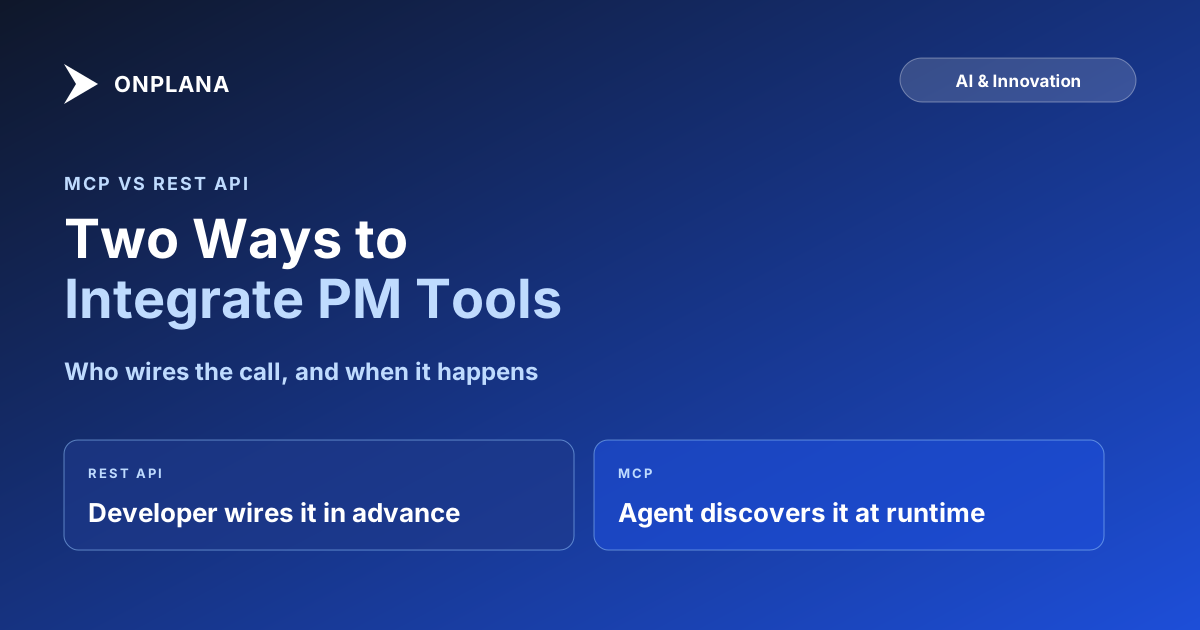
MCP vs REST API: Two Ways to Integrate PM Tools
MCP vs REST API is about who does the wiring: REST needs a developer to pre-code each call, MCP lets an AI agent discover and call tools at runtime.
MCP vs REST API sounds like a fight between two competing standards. It isn't one. A project management tool still needs a real REST API underneath, MCP doesn't replace it. The actual question is narrower and more useful: who does the integration work, and when does it happen. A REST API is an interface a developer wires up in advance, one client at a time. MCP is a protocol that lets an AI agent discover and call that same kind of interface itself, at runtime, under the permissions of whoever is signed in.
The direct answer: REST APIs and MCP servers solve different halves of the integration problem. REST defines what a tool can do; a developer picks specific endpoints and writes code that calls them in a known sequence, before any user ever runs the integration. MCP defines how an AI agent finds out what a tool can do and calls it itself, mid-conversation, without a developer having pre-wired that exact sequence. A tool that wants both a predictable nightly sync and a chat assistant that can act on live data typically needs a REST API for the first and an MCP server for the second, often built on top of the same underlying data layer.
What's Actually Being Compared
REST has been the default way to expose a web service's functionality for two decades; the Model Context Protocol is Anthropic's open standard, released in November 2024, for exposing that same kind of functionality to an AI model instead of to a developer. The confusion starts because both REST and MCP involve calling a function over HTTP with a JSON payload. Underneath, an MCP tool call and a REST API call often hit the same backend code. The difference is entirely in who decides which call happens and when.
With a REST API, a developer reads the documentation, decides which endpoints a specific integration needs, and writes code that calls them in a fixed sequence: fetch page 1 of projects, filter client-side, maybe fetch page 2. That code ships once and runs the same way every time, until a developer changes it.
With MCP, the tool vendor publishes a catalog of callable tools with typed schemas. An AI agent connects, reads that catalog at the start of the session, and decides for itself, based on what the user just asked, which tools to call and in what order. Nobody wrote a fixed sequence in advance; the model composes one on the fly for whatever the conversation needs.
MCP vs REST API: The Comparison Table
| Dimension | REST API | MCP |
|---|---|---|
| Who decides which calls to make | A developer, in advance, hard-coded into the integration | An AI agent, at runtime, based on the current conversation |
| Discovery | Read the API docs once; endpoints don't change per call | Agent queries the server's tool catalog at session start |
| Auth model | API key, OAuth token, or session cookie tied to the integration | OAuth 2.1 (interactive clients) or a scoped Personal Access Token (headless agents), tied to the connecting user |
| State across a task | Developer manages pagination, retries, and multi-step flows in code | Agent holds state in the conversation and issues follow-up tool calls as needed |
| Error handling | Developer writes explicit handling for each documented error code | Server returns a structured, model-readable error the agent reasons about directly |
| Integration effort per new AI client | Rebuilt or re-wired for every new client that wants to use it | Zero additional server work; any MCP-aware client can connect to the existing catalog |
| Best fit | Predictable, fixed-sequence jobs: nightly syncs, webhooks, dashboard queries | Conversational, adaptive tasks: "what's overdue across my projects," then acting on the answer |
The diagram below shows the same distinction as a flow: a REST integration is a path a developer draws once, an MCP connection is a path the agent finds itself from a published map.
When REST Is the Right Fit
REST is still the right choice for anything with a known, fixed call pattern. A nightly job that pulls timesheet actuals into a payroll system, a webhook receiver that reacts to a task status change, a Power BI dashboard querying the same three endpoints on a schedule: none of these need an agent deciding what to call next, because the sequence never changes. Writing that sequence once, in code a developer controls and can test deterministically, is simpler and cheaper than routing it through a model.
REST also wins when the integration has nothing to do with an AI agent at all: CI pipelines, ERP syncs, SSO provisioning shouldn't be forced through a model just because MCP exists.
When MCP Is the Right Fit
MCP earns its cost when the task itself is conversational and the right sequence of calls isn't known until the user asks the question. "What's overdue across my active projects, and which one is most at risk" isn't a fixed query; answering it well might mean calling a project-list tool, then a risk-analysis tool, then a task-detail tool, in an order that depends on what the first call returns. Pre-wiring every possible path a user might ask about doesn't scale; letting the agent discover the right tools and compose its own path does.
MCP also wins on reach: a vendor that builds one MCP server is reachable from every current and future MCP-aware client, with no client-specific code. What MCP actually unlocks, and what it doesn't covers that maintenance argument further, alongside the trust model that keeps an agent's access scoped to what its connecting user could already see.
What This Means for a Project Management Tool's Integration Surface
A PM tool built for 2026 needs both, not one instead of the other. The REST API stays the foundation: the durable, versioned interface that CI systems, BI dashboards, and fixed-sequence integrations depend on. An MCP server sits alongside it as a separate, agent-facing layer, usually built on the same underlying data and permission model, exposing a smaller set of semantically named tools instead of a REST-endpoint-for-REST-endpoint mirror.
Onplana's own MCP server is one worked example: it runs on top of the same permission model as the REST API, so a tool call from a connecting agent is checked against exactly the same role and plan gates a human user hits in the product. The engineering write-up on how it was built covers why a thin auto-generated wrapper over the REST API, one MCP tool per endpoint, produced a server the agent could barely use, and what the team built instead: a small, hand-designed tool catalog shaped around project-management concepts rather than HTTP routes.
The rest of the blog's AI & Innovation series covers the layers around this one in more depth, from the retrieval work that decides what data reaches a model to the governance controls that decide what it's allowed to change once it has an answer.
Frequently asked questions
Is MCP a replacement for REST APIs?
No. A REST API is the interface a tool exposes; MCP is a protocol that describes that interface to an AI model in a shape it can discover and call at runtime. A tool still needs a real API and a real permission model underneath. MCP doesn't replace either.
What is the main difference between MCP and a REST API?
A developer wires up REST API calls in advance, one integration per client. MCP exposes a catalog of tools that any MCP-aware AI client can discover and call itself, under the connecting user's own permissions, without custom integration code for each client.
When should a project management tool integration use REST instead of MCP?
REST is the right fit when a developer is building a specific, predictable integration: a nightly sync job, a webhook receiver, a fixed dashboard query. The call pattern is known in advance and doesn't need an AI agent deciding what to call next.
Can an AI agent do more through MCP than a human user could do through the same account?
No, if the server is built correctly. A well-designed MCP server checks the connecting user's existing role and plan permissions on every tool call, the same checks the REST API enforces, so the agent sees exactly what that person could see in the product.
Do I need to rebuild my REST API to add MCP support?
No. An MCP server is typically a new, agent-facing layer in front of the same underlying data and permission model the REST API already uses. It exposes a smaller set of semantically named tools instead of mirroring every REST endpoint one-for-one.
Ready to make the switch?
Start your free Onplana account and import your existing projects in minutes.