Team Accountability: One Owner Per Task, Visible Status
Team accountability is a structure, not a value: one named owner per task, a status anyone can read and a record of decisions. Here is how to set it up.
Most accountability problems are not attitude problems. They are tasks that two people each believed the other one had, and a status that lives in someone's head until a meeting drags it out. Of the roughly 500 schedules the free Schedule Health Check processed in the first quarter of 2026, 83% held at least one task with no predecessor and no successor (source: our audit of 500 project schedules): work that nothing waits on and nobody is visibly chasing.
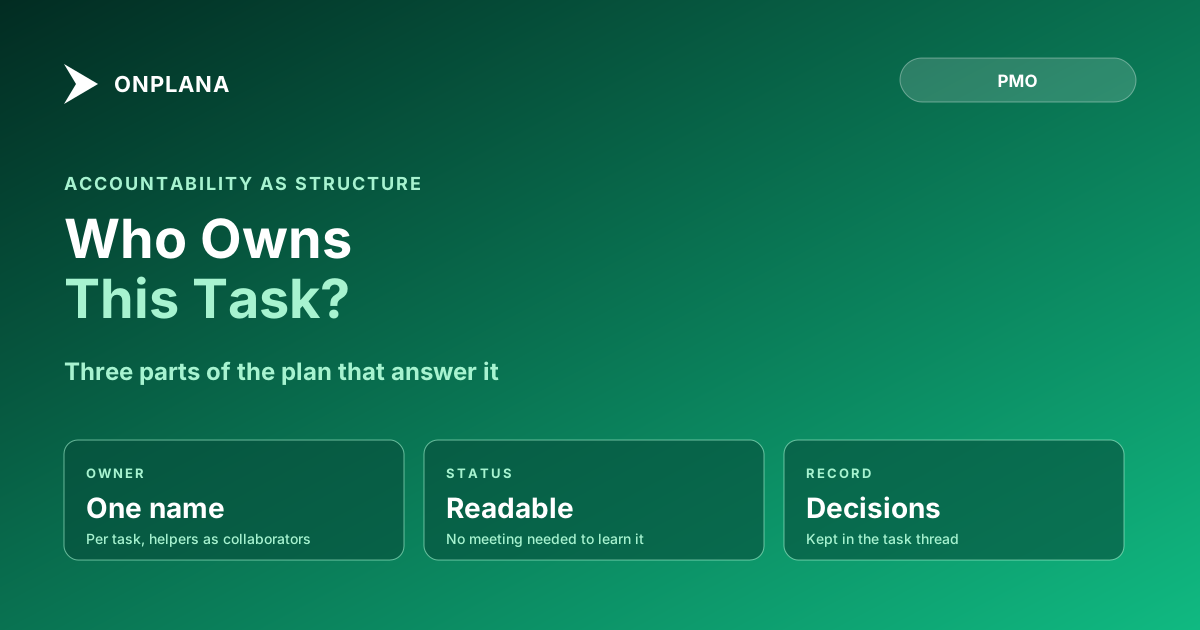
The short answer. Team accountability is built from three parts: one named owner per task, a status anyone can read without asking, and a record of what was decided and by whom. Put all three on the plan itself and accountability stops depending on memory, good intentions or who spoke last in the meeting.
What does team accountability need to work?
It needs a structure that makes the answer to "who has this?" a lookup rather than a conversation. A team agreement or a values workshop does not supply that; a plan does. The table shows the three parts and what each one replaces.
| Part | What it is on the plan | What it replaces |
|---|---|---|
| One owner | A single accountable assignee on each task | "I thought you had that" |
| Visible status | Status, due date and progress readable by anyone with access | The status-update meeting |
| Decision record | A comment thread on the task, with replies and @mentions | A chat message nobody can find in a month |
The diagram below shows the same three parts as one loop: an owner sets status, status raises a question, and the answer is recorded where the next person will look.
How do you give every task one owner?
Name one person on each task and add everyone else as a collaborator. Onplana keeps one accountable assignee per task and lets you add up to 20 collaborators, the other people working on it; this is available on every plan, including Free. Collaborators see the task in their My Work view, are notified when they are added and when someone comments, and can update it as their project role allows.
- Scan the plan for tasks with no assignee. Each one is a task nobody is accountable for yet.
- Assign one person per task, the one who will answer if it is late, not the one who does most of the typing.
- Add the rest of the people working on it as collaborators.
- Review the owner column weekly, and treat a stale or empty owner as a finding rather than a gap in the data.
The same split is what a responsibility matrix formalises for larger efforts; RACI, RASCI and DACI compared covers when the heavier version earns its overhead.
What makes status visible without a meeting?
Status is visible when it sits on the work and the people who need it can open it. Each person gets a My Work view of the tasks they own or collaborate on, and managers get portfolio health across projects, so nobody needs a status call to learn what is late. The one rule that matters is that the owner sets it, in a convention the whole team shares; RAG status light conventions sets out what red, amber and green should mean so that red is allowed.
Where should the decision record live?
On the task, in its comment thread. Comments carry replies and @mentions, and a mention reaches the person's inbox, email and phone, so a question gets to the right owner and the answer is stored beside the work. Chat is faster and worse for this; task comments versus a chat channel explains where each belongs. The test is simple: six weeks later, a new owner should be able to open the task and see what was decided and by whom.
How does accountability work when an agent does the work?
An agent is accountable to the person who reviews its output, and the tool should make that review unavoidable. In Onplana you use "Delegate to an agent" on a task, which posts an @mention; the agent reacts on its next sync, and anything it produces lands in the Agent review inbox. Nothing is sent or published until a person approves it, and an agent never sends email on its own. That keeps the single-owner rule intact: the human who delegated the task is the human who answers for the result. The reasoning is set out in who is accountable when an agent is wrong, and approving agent work without reading everything covers how to review at volume. For the wider picture of teams, clients and agents on one plan, see team collaboration in Onplana.
To see where your own team stands on ownership and governance before changing anything, run the free PMO Maturity Assessment.
Check how mature your governance is The free PMO Maturity Assessment scores ownership, reporting and governance habits in a few minutes and shows where to start. No signup required. → Open the assessment
Frequently asked questions
How do you build team accountability?
Give every task one named owner, make status readable without asking anyone, and keep decisions in a comment thread on the work itself. Accountability follows from that structure far more reliably than from a team agreement.
Can a task have more than one owner?
It should not. Onplana keeps one accountable assignee per task and lets you add up to 20 collaborators, the other people working on it, so help is visible without blurring who answers for the result.
What if the owner is overloaded or on leave?
Then the owner field is still the right place to see it, because an empty or stale owner shows up in the plan instead of in a missed deadline. Reassign the task and leave a comment saying why; the thread records the handover.
Who is accountable for work an AI agent does?
The person who assigned the work and reviews the output. In Onplana an agent's output lands in the Agent review inbox and nothing is sent or published until a person approves it, so a named human always answers for it.
Does this work for client teams outside the company?
Yes, with a limit. A client can be given one project or one document through a guest seat, which every paid plan includes, but guests see only what they are given and are not a substitute for an internal owner.
Where does this approach fall short?
It makes ownership visible; it does not make people care. A plan with a name on every task still needs a manager who reads it, and a status field only helps if the people who set it are allowed to say red.
Ready to make the switch?
Start your free Onplana account and import your existing projects in minutes.