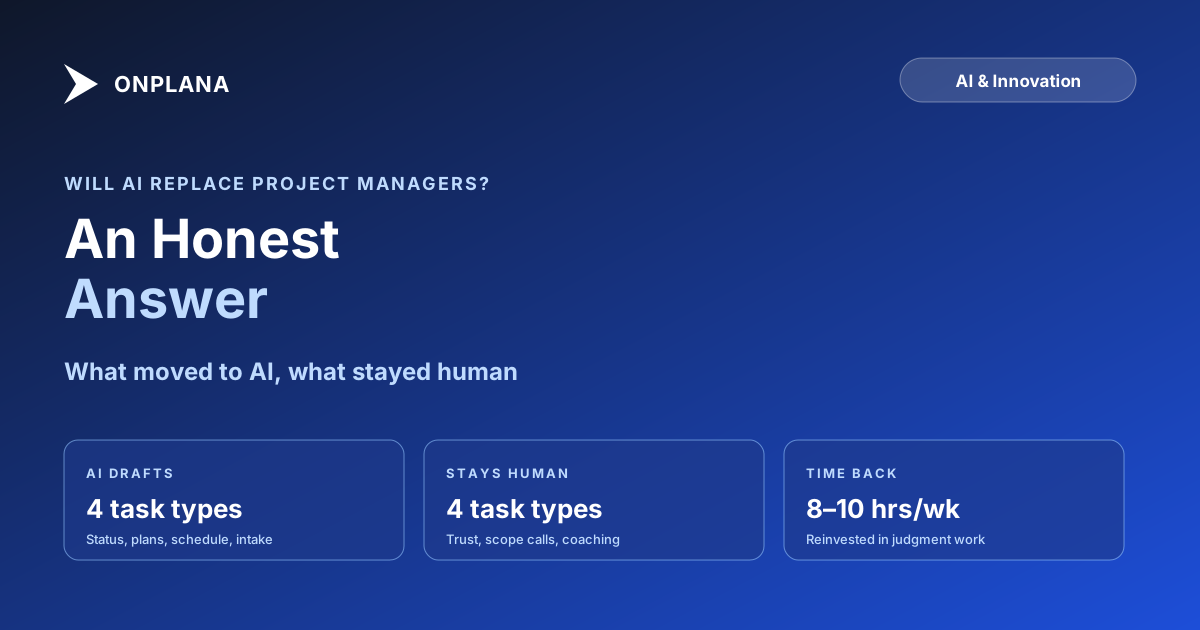
Will AI Replace Project Managers? An Honest Answer
Will AI replace project managers? No, but it already ate the busywork. Here's exactly which PM tasks moved to AI, which didn't, and why the split holds.
Ask a project manager whether AI is coming for their job and you get a defensive laugh or a nervous one. Both reactions skip the actual question. AI is not coming for project management. It already arrived, and it ate the parts of the job that were never really the job in the first place: retyping a status update that already existed in the underlying task data, assembling a task list from a kickoff conversation, chasing down which item on a 40-line schedule is now overdue. What's left standing is what a PM was paid for from day one.
That's the honest answer to "will AI replace project managers": no, but pretending the job hasn't already changed shape is its own kind of dishonesty.
TL;DR. AI does not replace project managers; it replaces the specific PM tasks that were always mechanical rather than judgment-based: status report drafting, plan boilerplate from a brief, schedule bookkeeping, and intake parsing. What stays firmly human: stakeholder trust, scope and priority decisions, team coaching, and any call where someone has to be accountable for being wrong. The role is changing (less typing, more judgment) rather than disappearing, following the same pattern earlier waves of workplace automation already set.
The Honest Answer, Stated Plainly
No, AI does not replace project managers, and the reason is not sentimental. Project management is fundamentally a job of managing people who usually don't report to you, reading a room that a status dashboard can't capture, and making calls under incomplete information where someone has to own the consequences. None of that is a task AI performs today, and none of it is close to becoming one.
What AI does replace is the layer of PM work that looks like "project management" on a job description but was always closer to clerical throughput: typing up what a dashboard already shows, building a first-draft schedule from a conversation that already happened, chasing down status from six different people instead of reading it off the actual task data. That layer is real work, it took real hours, and AI is now faster and more consistent at most of it than a tired PM at 4pm on a Friday.
Which PM Tasks Actually Move to AI
Four categories account for most of what's already shifted, and none of them involve AI deciding anything on its own behalf.
Status report drafting. A first-draft weekly status pulled directly from live task, risk, and milestone data, ready for a PM to edit and ship, not publish unsupervised. The PM still decides what tone the report takes and what gets emphasized for a nervous sponsor; AI just removes the blank-page problem.
Plan and task-tree generation. A plain-English brief ("stand up a customer data migration for 40 users by Q3") becomes a starter set of tasks, milestones, and flagged risks in seconds instead of an hour of manual scaffolding. The PM still edits it, reassigns owners, and adjusts dates against real constraints AI doesn't know about.
Schedule and risk bookkeeping. Overdue-task scanning, dependency-break detection, and resource-conflict flags run continuously instead of during a Monday-morning manual sweep. This is exactly the kind of pattern-detection work a model does well and a human does inconsistently under time pressure.
Intake and natural-language parsing. "Add a task for Sara to review the API spec by Friday" becomes a structured task with the right assignee and due date, without a PM hand-typing it into a form. Concrete prompt patterns for this kind of intake work are now closer to muscle memory for PMs who've adopted them than a novelty.
Every one of these four is production of an artifact, a report, a plan, a flagged risk, a task. None of them is a decision that sticks without a human accepting it first.
What AI Still Can't Do, and Why That Isn't About to Change
Four things remain stubbornly human, and the reason is structural, not a temporary capability gap current models will close next year.
Building stakeholder trust. A sponsor who hears "we're three weeks behind" from a PM they've worked with for two years reacts differently than the same sentence from an unfamiliar source. Trust is accumulated through a track record of being right and being straight about bad news, and it attaches to a person, not to whichever tool generated the sentence.
Negotiating scope under pressure. Telling a stakeholder their favorite feature has to be cut is a conversation with real social and political cost, one that requires reading what the stakeholder actually needs to hear versus what they're asking for. AI can model the schedule impact of the cut. It cannot have the conversation that gets the stakeholder to agree to it.
Coaching and managing people. A team member who's quietly disengaged, a contractor who needs a harder conversation about quality, a junior PM who needs a specific kind of feedback to grow, none of this is data AI has clean access to or the standing to act on even if it did.
Being accountable when it goes wrong. When a project fails, someone answers for it in a room with real consequences to their career and the organization's trust in them. That accountability can't be assigned to a model; it has to sit with a person who had the authority to make the calls that led there.
This is the same distinction Onplana's own act, suggest, stay-out boundary draws at the product level: operations cheap to undo and cheap to get wrong sit in AI's autonomous zone, operations with real financial or interpersonal cost, baseline sign-off, performance reviews, vendor decisions, sit in a zone AI is never allowed to touch regardless of settings. The boundary in the product mirrors the boundary in the job.
Why "AI Replaces PMs" Gets the Automation Curve Wrong
Every meaningful automation wave has followed the same shape, and it's worth naming because the "AI replaces the job" framing keeps getting the shape backwards. Spreadsheets did not replace accountants; they replaced the manual arithmetic that used to eat an accountant's week, and left the judgment (what does this number mean, what should we do about it) to the human. CAD software did not replace engineers; it replaced hand-drafting, and left the engineering judgment intact. In both cases the job title survived, the day-to-day content of the job changed substantially, and the people who adapted fastest gained a real productivity edge over the ones who didn't.
AI in project management is tracing the identical curve. It automates the production of artifacts, plans, reports, task breakdowns, and leaves the judgment about what those artifacts should say to the person accountable for the outcome. The diagram below shows the shift concretely: the same working day, before and after, with the hours that moved and the hours that didn't.
That reallocation, hours moving out of mechanical production and into judgment work, is documented in practice: a full working-day walkthrough of an AI-augmented PM's day shows roughly 8 to 10 hours a week shifting from typing and status-chasing into stakeholder time, with the shape of the day looking similar and the texture completely different.
How the PM Role Changes Over the Next Few Years
The title survives; the day-to-day content underneath it is what moves. Expect three concrete shifts to keep compounding.
Less time producing, more time reviewing and deciding. A PM's default posture with AI-drafted plans and reports is closer to an editor's than an author's: read the draft, catch what's wrong or missing, decide what actually ships. That's a different skill emphasis than writing from a blank page, and it rewards judgment over typing speed.
More responsibility for verifying AI output before it reaches a stakeholder. How AI actually runs inside a modern PM tool matters more to a PM's day-to-day now than it used to, because the PM is the last check before an AI-drafted artifact goes external. Understanding what the model is grounded in (real task data versus an unsupported guess) becomes a core competency, not a curiosity.
A widening gap between PMs who adopt the tools and PMs who don't. The productivity difference between a PM reviewing an AI-drafted status report and one still typing from scratch compounds weekly. Over a year, that gap is large enough to be visible in performance reviews, not just in personal convenience.
More portfolios per PM, not fewer PMs per portfolio. The mechanical time savings tend to show up as capacity rather than headcount reduction. A PM who used to run a handful of active projects at a sustainable pace has more room to take on additional ones once status drafting, plan scaffolding, and risk scanning stop eating the calendar. That is a shift in how many projects one PM can carry, not evidence that fewer PMs are needed overall.
None of these shifts touch the parts of the role that justify a PM's presence in the first place. They move the job further from typing and closer to the judgment work a computer still can't do.
Is the Fear About AI Replacing PMs Justified?
Partly, and it's worth being precise about which part. The fear is misplaced if it's about the title disappearing: nothing in how AI actually performs today suggests it can carry the accountability, trust-building, and negotiation load a real PM role requires. The fear is well-founded if it's about falling behind peers who adopt the tools faster: a PM still hand-typing every status report and manually scanning for overdue tasks in 2026 is doing strictly more low-value work than one who isn't, and that gap shows up in output, not job security directly, but eventually in who gets trusted with the harder projects.
The practical takeaway is to treat AI adoption as a skills question, not an existential one. Learn to work from an AI-generated first draft instead of a blank page, learn what the model is and isn't grounded in before trusting its output, and reinvest the reclaimed hours into the stakeholder and team work that was always the actual job.
What to Do About It as a PM Today
- Turn on AI drafting for your highest-frequency mechanical task first, usually the weekly status report, and measure how much editing time it actually takes versus writing from scratch.
- Audit which of your current tasks are production versus judgment. Anything that's pure production (typing up numbers that already exist elsewhere) is a near-term automation candidate regardless of which tool you use.
- Reinvest the reclaimed hours deliberately, not passively. Block the time for stakeholder conversations or team coaching rather than letting it get absorbed into more meetings.
- Learn what your AI tools are actually grounded in. A model citing real task data is trustworthy in a different way than one generating plausible-sounding text with no retrieval behind it.
- Keep the accountability calls explicitly yours. Never let an AI-drafted recommendation on a scope cut, a resourcing decision, or a schedule commitment ship without your own judgment applied on top of it.
The honest forecast for project management and AI is neither the replacement narrative nor the dismissal narrative. It's a role that keeps the title, sheds the mechanical half of the job, and asks more, not less, of the judgment that was always the actual point of having a PM in the room. The same caution NIST's guidance on understanding AI system limitations recommends before relying on any AI output applies directly here: know what the tool is actually good at before deciding what to hand it.
Frequently asked questions
Will AI replace project managers?
No. AI takes over the parts of PM work that were high-volume and low-judgment, status report drafting, plan boilerplate, schedule bookkeeping, intake parsing. Stakeholder trust, scope and priority decisions, and politically difficult calls stay with a human, and those were always the parts of the job that actually justified the title.
Which project management tasks is AI already doing well?
First-draft status reports from live task data, generating a starter plan and task tree from a plain-English brief, parsing natural language into structured tasks, flagging schedule and resource risks from patterns in the data, and answering portfolio questions with citations. All five are drafting or detection tasks; none of them commit a decision on their own.
What can't AI do in project management, even now?
It can't build the trust a sponsor needs to believe a hard status update, negotiate a scope cut with a stakeholder who doesn't want to hear it, coach an underperforming team member, or take accountability when a project fails. Those require a relationship and a stake in the outcome that a model doesn't have.
How is the AI-and-project-management shift different from past automation waves?
Spreadsheets automated calculation and didn't replace accountants; they made accountants faster at the parts of the job that were never the judgment part. AI in project management is following the same shape: it automates production of artifacts (plans, reports, task lists), not the judgment about what should be in them.
How should a project manager prepare for AI taking over more of the job?
Get fluent with the AI-drafted version of your own outputs so you can edit fast instead of writing from scratch, and spend the reclaimed hours on the work AI can't do: stakeholder conversations, coaching, and the calls that require someone to be accountable. PMs who treat AI as a first-draft generator gain time; PMs who ignore it lose the productivity gap to peers who don't.
Are project management jobs at risk from AI in the way some other roles are?
Less than roles built entirely around producing the kind of artifacts AI now drafts well (routine reporting, data entry, first-pass scheduling). The core of PM work, judgment under uncertainty and managing people who don't report to you, doesn't have a clean automation path, which is why the honest forecast is role change rather than role elimination.
Ready to make the switch?
Start your free Onplana account and import your existing projects in minutes.