A PM Tool RFP Template That Surfaces Real Differences
A PM tool RFP template that surfaces real differences: five sections, the demo-on-your-data question, and how to weight vendor answers before you buy.
Pull up the last PM tool RFP your team sent out. Find the section asking about dependencies. Does it ask "does the tool support task dependencies," or does it ask the vendor to import a file with all four dependency types and non-zero lag values, then show what survived? If it's the first version, every vendor who reads it will answer yes, and the RFP will have told you nothing.
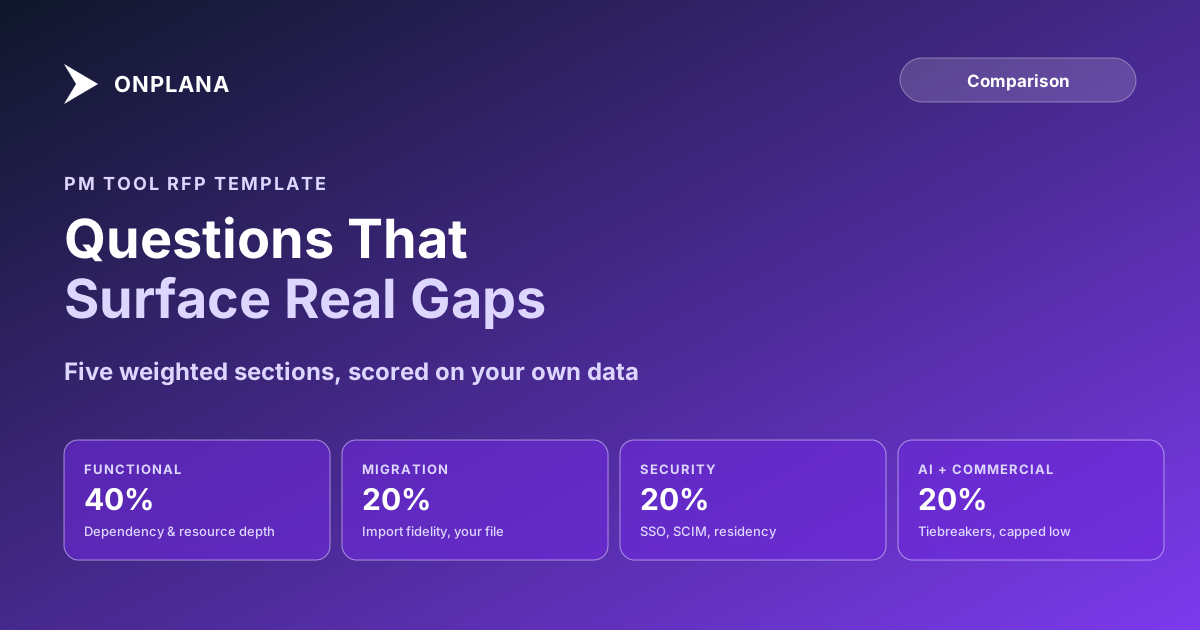
A PM tool RFP template that actually surfaces real differences replaces yes/no questions with evidence requirements: five sections covering functional depth, data migration fidelity, deployment and security, AI capabilities, and commercial terms, each scored on a weighted rubric so the vendor who wins on paper is the vendor who also wins the live demo on your own data.
The short version Weight the sections: functional (40%), data migration (20%), security (20%), AI (10%), commercial (10%). Require every finalist's demo to run on a file or dataset you provide, not the vendor's rehearsed sample. Score with a rubric (0-5 per item), not a yes/no column; ties get broken by the live demo, not the paperwork.
Why a Generic RFP Produces Generic Answers
A request for proposal exists to let vendors propose tailored solutions rather than just quote a price, which only works if the questions are specific enough to produce a tailored answer. A checklist RFP asks "does the tool support X" and gets "yes" from every vendor, whether X is fully built or barely functional. The fix is not more questions; it's questions that require the vendor to show, not tell. "List every supported dependency type and confirm whether lag values survive a round-trip import" cannot be answered with a single word, and a vendor who can't answer it in detail has just told you the honest answer to the original yes/no question.
The Five-Section PM Tool RFP Template
| Section | Weight | What it's really testing |
|---|---|---|
| Functional requirements | 40% | Scheduling depth, resource model, reporting, the features you'll actually configure |
| Data migration fidelity | 20% | Whether your existing data survives import intact, not just "imports" |
| Deployment and security | 20% | SSO/SCIM, data residency, compliance certifications, minimum bar not a differentiator |
| AI capabilities | 10% | Production features you can demo today, not roadmap slides |
| Commercial terms | 10% | Full multi-year TCO and exit terms, not the sticker price alone |
Cap commercial terms at 10%. A tool that's 15% cheaper but fails the functional and migration sections costs far more in re-entry and workaround labor than the license savings return.
Functional requirements, sample questions:
- List every dependency type supported (finish-to-start, start-to-start, finish-to-finish, start-to-finish) and confirm lag/lead value support with a live example.
- Describe how baselines are stored: as historical timeline records you can view against the current schedule, or as flat date fields.
- Confirm resource leveling behavior: does it respect existing dependency constraints, or does it move dates without regard to the critical path?
Data migration fidelity, sample questions:
- Run a live import of a file we provide (not a vendor sample) and produce a field-by-field comparison of source versus imported result.
- Describe how custom or enterprise fields are handled: preserved with their original type, or coerced to plain text?
Deployment and security, sample questions:
- Provide a current SOC 2 Type II report and confirm available data residency regions.
- Confirm supported SSO protocols (SAML 2.0, OIDC) and SCIM provisioning support.
AI capabilities, sample questions:
- Describe every AI feature currently in general availability (not roadmap), including what data it reads and where inference runs.
- Demonstrate one AI feature live on a schedule we provide, not a recorded video.
Commercial terms, sample questions:
- Provide a full multi-year total cost model at our seat count: license, implementation, training, support.
- Confirm data export terms: is our data portable in a standard format, on demand, at no fee, for the life of the contract?
The diagram below shows how the weighting concentrates the score where the risk actually sits.
The Demo-on-Your-Data Rule
The single highest-leverage line in any PM tool RFP is the requirement that the live demo runs on a file or dataset you provide, not the vendor's rehearsed sample project. A vendor's own sample data is chosen to make every feature look good; your real schedule, with its actual dependency mix, resource conflicts, and messy history, is the only dataset that tells you what will happen after the contract is signed. Reserve the right to disqualify any finalist who declines this requirement. If your evaluation is specifically for a Project Online replacement, the Project Online-specific RFP template extends this same structure with the exact enterprise custom field and OData questions that migration requires, and the free Migration Preview tool gives you a first look at what that migration path looks like before the RFP even goes out.
Scoring and the Follow-Up Questions That Turn a Demo Into a Decision
Score each response 0-5 per item, multiply by section weight, and sum. The highest weighted score advances to the live demo. During the demo, the questions that matter are the follow-ups: when a feature works, ask what happens at the edge case (a dependency with negative lag, a resource assigned across two conflicting projects). Vendors who answer the edge case confidently have built the feature properly; vendors who deflect to "we can look into that" have found the gap the RFP was designed to surface.
For a deeper look at the six underlying criteria this template scores against, and how to weight them for your specific organization, see PM tool evaluation criteria that actually predict fit.
Preview your migration before the RFP goes out Walk through what moving your schedules and resource pools actually looks like, field by field, in about 10 minutes. No signup required. → Open Migration Preview
Microsoft Project Online™ is a trademark of Microsoft Corporation. Onplana is not affiliated with Microsoft.
Frequently asked questions
What should a PM tool RFP template include?
Five sections: functional requirements, data migration and import fidelity, deployment and security, AI capabilities, and commercial terms. Weight functional requirements and migration fidelity highest, since they're the hardest gaps to discover after signing.
Why do generic RFPs produce useless vendor responses?
Because a yes/no question always gets a yes. 'Does your tool support dependencies' is true of a tool with one dependency type and true of a tool with four. Descriptive, evidence-based questions are what separate real capability from a checked box.
Should vendors demo on their own sample data or mine?
Yours, always. Require every finalist to run the live demo on a file or dataset you provide, ideally your most complex real project. A vendor who declines is telling you something about what the demo would show on real data.
How do I weight the sections of a PM tool RFP?
A workable default: functional requirements 40%, data migration fidelity 20%, security and deployment 20%, AI features 10%, commercial terms 10%. Capping commercial terms low keeps a cheap-but-shallow tool from winning on price alone.
Ready to make the switch?
Start your free Onplana account and import your existing projects in minutes.