Internal vs External Stakeholders on a Shared Project Plan
External stakeholders are people outside your organisation whom a project affects. See how they differ from internal ones and what each should see of the plan.
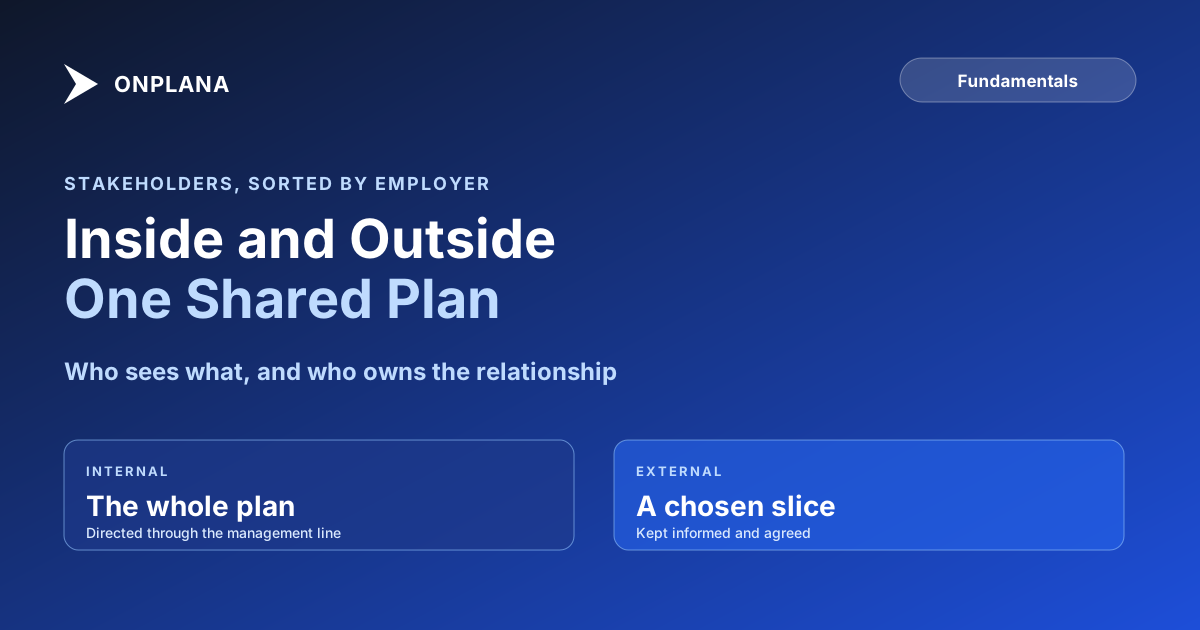
An external stakeholder is a person or organisation outside the team delivering your project whose interests the project touches: a client, a vendor, a regulator, a partner. An internal stakeholder sits inside your own organisation. The difference that matters is control. You can direct an internal stakeholder through the management line; you can only keep an external one informed and agreed. The Project Management Institute's research on communication found that organisations rated highly effective at it met their original project goals 80 percent of the time, against 52 percent for minimally effective ones (PMI Pulse of the Profession, 2013).
In short. Internal stakeholders can be directed and can see the whole plan. External stakeholders cannot be directed, so they need a deliberately limited view of the plan, a named owner on your side, and a place to comment that is not your inbox. Decide which group each person belongs to first; it sets what they see and how often they hear from you.
What are external stakeholders?
External stakeholders are everyone with a stake in the project who does not work for the organisation delivering it. The usual groups are clients and customers, vendors and contractors, regulators and auditors, partners, and the end users who live with the result. Their stake is real, and most have a veto of some kind (a client signs off, a regulator approves), but none of them take instructions from your sponsor.
That is why the standard advice to "manage stakeholders" misleads for this group. You cannot assign an external stakeholder a task by decree, so the work is agreement: what they need from the project, when, and how much of the plan they are shown. For deciding who gets attention first, use stakeholder mapping on power and interest once the groups below are sorted.
Internal vs external stakeholders: how they differ
The table below sorts the two groups on the five questions that decide how you treat them. The diagram after it shows the same split as what each group sees of one plan.
| Internal stakeholders | External stakeholders | |
|---|---|---|
| Who they are | Sponsor, team, line managers, finance, other departments | Clients, vendors, regulators, partners, end users |
| How you reach them | Management line, team meetings, the project tool | Agreed channel, scheduled updates, a limited view |
| What they need | Progress, risks, resourcing, budget | Their deliverables, dates they depend on, decisions asked of them |
| How much of the plan they see | All of it, within role permissions | A slice chosen per group |
| Who owns the relationship | The project manager or sponsor | A named person on your side, one per group |
Which stakeholders count as external on a client project?
It depends on whose project it is, and the same person can switch sides. On an agency or consulting engagement, the client's sponsor is external to you, even though they hold the budget. For the client's own internal team, the same engagement is an internal project. A contractor working inside your plan is external to your organisation but works like a team member day to day, which is the case one project shared by a contractor, a client and an in-house team walks through.
Sort people by employer, not by influence. High-influence external stakeholders get more of your time, not more of the plan.
What should you share with each external group?
Share what the group decides or delivers, and nothing else. A client needs the milestones, the deliverables it approves and the dates it owes you input. A vendor needs the tasks it owns and the tasks waiting on it. A regulator needs the evidence and the submission dates. Start from this list:
- Name the group and the one person on your side who owns the relationship.
- List the decisions you need from them and the dates those fall on.
- Pick the smallest slice of the plan that lets them make those decisions.
- Choose one channel for questions, ideally on the work itself.
- Review the slice when scope or dates change.
Emailing an export fails step 5 immediately; the attachment is out of date by the next status meeting. The stakeholder communication post covers the table of what each audience needs and how to deliver it where the work is.
How do you give external stakeholders access without emailing exports?
Give them a view of the live plan, scoped to what they should see. In Onplana the options are:
- Guest seats for people who need standing access to one project, including comments. Free on every paid plan up to an allowance (2 on Starter and Professional, 5 on Business, 10 on Enterprise), and none on the Free plan. A guest cannot see other projects, billing or the wider workspace. See guest seats explained.
- A document share for one file, with no account: the recipient enters a code sent to their email. It is free on every plan; the shared documents with clients post has the steps.
- Public share links on reports from the cross-project report builder, which need no login.
Plan allowances change, so check pricing before you promise a client access. If the people involved already work inside the workspace, team collaboration covers comments, mentions and how the pieces fit.
Run one check before the next update goes out: for each external group, can you name the owner, the slice they see, and the decision you need from them? Where any of the three is blank, fix that before the next status meeting.
Frequently asked questions
What are external stakeholders?
External stakeholders are people and organisations outside the team delivering the project whose interests the project touches, such as clients, vendors, regulators and partners. They do not report to the project sponsor, so you influence them through agreement and communication rather than instruction.
What is the difference between internal and external stakeholders?
Internal stakeholders sit inside the delivering organisation and can be directed through its management line; external stakeholders sit outside it and cannot. The practical difference is how much of the plan each may see and how you reach them.
Should external stakeholders see the full project plan?
Usually not. Give each external group only what its role needs: a client sees milestones and the deliverables it approves, a vendor sees the tasks it owns, and a regulator sees the evidence it asked for. Internal cost, margin and staffing detail stays inside.
Can I give a client access to a project without buying them a licence?
On a paid Onplana plan, yes. Guest seats are included free up to a plan allowance (none on the Free plan), and a guest sees only the project they were invited to. A single document can also be shared without any account.
Is a sponsor an internal or an external stakeholder?
A sponsor is internal when they belong to the delivering organisation. On a client engagement the client's sponsor is external, even though they hold the budget and the final say.
How often should I update external stakeholders?
Match the cadence to what they decide. A client approving milestones needs an update at each milestone and a standing view in between; a regulator may need updates only at defined submission points.
Ready to make the switch?
Start your free Onplana account and import your existing projects in minutes.